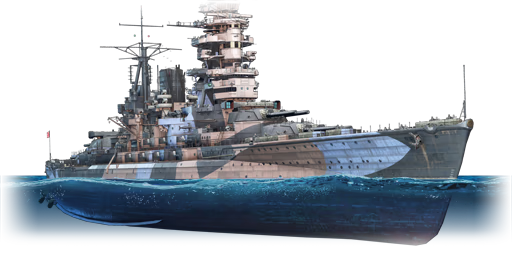
Nagato (長門, namesake: Nagato Province) was a battleship of the Imperial Japanese Navy, the lead ship of her class. She was laid down on 28 August 1917, launched on 9 November 1919, and commissioned on 25 November 1920. In 1923, she participated in the relief efforts following the Great Kantō Earthquake. The battleship spent the remainder of the 1920s primarily engaged in exercises and target practice. In 1931, she was placed in reserve and underwent modernisation of her anti-aircraft battery. From 1 April 1934, she underwent a major modernisation that lasted until 31 January 1936. On February 26, during an attempted coup d'état, the battleship provided support to government forces. She also took part in the Second Sino-Japanese War. In early 1941, she underwent further modernisation. During the Pacific War, she participated in most major battles — the Battle of Midway, almost all engagements of the Battle of Leyte Gulf — and frequently escorted the Japanese fleet's carrier forces. On 24 October 1944, during the Battle of the Sibuyan Sea, the battleship was hit twice by bombs, which caused only minor damage.
The battleship later participated in the Battle of San Bernardino Strait and the Battle of Samar Island, where, according to the crew, it scored hits on enemy light cruisers. In November 1944, Nagato returned to Yokosuka for repairs but was unable to sail again due to a shortage of fuel and supplies. The ship was converted into a floating anti-aircraft battery; its funnel and main mast were removed, and its anti-aircraft battery was reinforced. By June 1945, most of its secondary and anti-aircraft guns, along with its searchlights and rangefinders, had been removed. In July, Nagato was attacked by American bombers and sustained damage, although not significant. Nevertheless, to convince the Americans otherwise, the damage was left unrepaired, and water was pumped into its ballast tanks to reduce buoyancy. On 30 August, control of the battleship passed to the Americans. By that time, Nagato was the only battleship in the Imperial Japanese Navy still afloat. In 1946, the ship was selected as one of the targets for Operation Crossroads, a series of nuclear tests. The ship survived an airburst 1.5 kilometres away and an underwater explosion, but afterward she began to list slightly. Over the next five days, the list increased, and on the night of 30 July 1946, Nagato capsized and sank.
IJN Nagato was introduced in Update 2.51 "Spearhead" in her 1944 configuration. She possesses powerful 410 mm main guns with an excellent rate of fire, boasts fairly good protection, and has an excellent anti-aircraft battery. Her manoeuvrability, while decent for a ship of her class, is still quite average.