
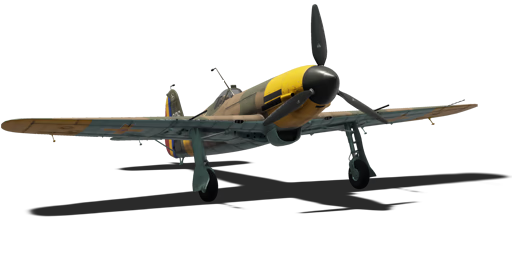



The IAR-80 was the most-produced Romanian fighter of the Second World War, with roughly 450 built. It was designed by the Romanian state-run company Industria Aeronautică Română (IAR). The most advanced variant produced during the war was the IAR-81C, which began production in 1942. Beginning in mid-1941, recognising the limitations of the underpowered IAR 14 K IV c 32 engine, IAR began searching for a new powerplant, primarily from Germany. The first engine tested was a Daimler-Benz DB 601 Aa taken from a Bf 109 E, which was fitted to IAR-80 airframe Nr. 13 in April 1941. However, very strong vibrations in the airframe made it difficult to fly, and pilot Dudu Frim could barely land it. Two years later, IAR revisited the concept. This time, they fitted a much more powerful DB 605 A engine to IAR-81C airframe Nr. 326. Tests were conducted from 29 June to 20 August 1943. The aircraft performed excellently, and it was decided that new aircraft would be equipped with this engine and that older ones could potentially be retrofitted. However, it ultimately could not be put into production because Germany did not have enough engines to sell, and Romania had difficulty producing them.
The IAR-81C (DB 605) was introduced as a reward for Battle Pass Season XXIV "Do It Yourself". Compared to the IAR-81C, it performs far better: manoeuvrability is still average, but the much more powerful engine greatly increases its speed and provides far better energy retention. These factors make the aircraft much more effective in dogfights. It also possesses a greatly increased rate of climb, allowing it to reach a much better starting position at higher altitude early in matches. The 20 mm cannons, being the same as those on the baseline IAR-81, are extremely potent against any aircraft. It can also carry rockets and 50 kg bombs, allowing it to deal with some more lightly armoured ground targets.

flaps
flaps
flaps
brake
| Belt | Belt filling | Armor penetration (mm) at a distance: | |||||
|---|---|---|---|---|---|---|---|
| 10 m | 100 m | 500 m | 1000 m | 1500 m | 2000 m | ||
| IT/IT/APHE/HEI | 20 | 18 | 10 | 5 | 4 | 4 | |
| IT/HEI/HEI/AP-I | 27 | 24 | 14 | 7 | 3 | 2 | |
| AP-I/HEI/HEI/HEI/HEI/IT | 27 | 24 | 14 | 7 | 3 | 2 | |
| APHE/APHE/APHE/IT | 20 | 18 | 10 | 5 | 4 | 4 | |
| FI-T/FI-T/FI-T/IT/IT | 10 | 9 | 5 | 3 | 2 | 1 | |
| HEI/HEI/HEI/APHE/AP-I | 27 | 24 | 14 | 7 | 3 | 2 | |
| Belt | Belt filling | Armor penetration (mm) at a distance: | |||||
|---|---|---|---|---|---|---|---|
| 10 m | 100 m | 500 m | 1000 m | 1500 m | 2000 m | ||
| AP-T/Ball/Ball/AP-I/AI | 9 | 8 | 6 | 3 | 0 | 0 | |
| AP-T/AP/AI/AP-I | 13 | 12 | 7 | 3 | 2 | 0 | |
| AP-T | 9 | 8 | 6 | 3 | 0 | 0 | |
| AI/AP/AP/AP/AI | 13 | 12 | 7 | 3 | 2 | 0 | |
| Name | Weight | Slot | ||||||
|---|---|---|---|---|---|---|---|---|
| 112 kg |  | | ||||||
| 50 kg |  | | ||||||


 2 x (55 / 135 / 280) %
2 x 136 %
2 x (55 / 135 / 280) %
2 x 136 %
Flight performance | |
|---|---|
Survivability |
|---|
Weaponry | |
|---|---|