
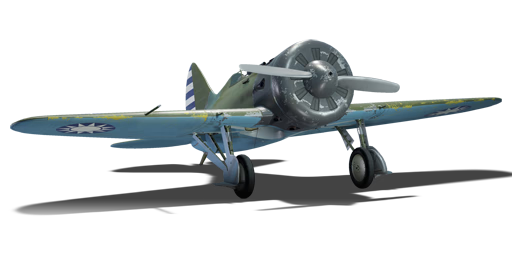
␗I-16 type 5




The I-16 type 5 is a modified version of the Soviet single-engine monoplane fighter developed in the 1930s by the design bureau of aircraft designer Nikolai Polikarpov. The I-16 was one of the world’s first mass-produced monoplane fighters with retractable landing gear. Developed in 1935, the Type 5 was an evolution of the I-16 Type 4; its main difference was the installation of a more powerful M-25A engine, along with minor structural changes. Between 1936 and 1937, a total of 2,895 I-16 Type 5 aircraft were built. These aircraft were supplied to China under Chiang Kai-shek as military aid during the Second Sino-Japanese War (1937–1945), and they were used by the Republic of China Air Force in the Battle of Nanjing.
The Chinese I-16 type 5 was introduced in Update 1.91 "Night Vision". With its excellent maneuverability, matched only by some Japanese fighters, decent armament, and good climb rate, the aircraft is suitable for both dogfighting and hit-and-run tactics. However, its high maneuverability comes at the expense of survivability; the aircraft has no armor, and the M-25A engine is prone to overheating.

flaps
flaps
flaps
brake
| Belt | Belt filling | Armor penetration (mm) at a distance: | |||||
|---|---|---|---|---|---|---|---|
| 10 m | 100 m | 500 m | 1000 m | 1500 m | 2000 m | ||
| T/Ball/Ball/AP-I/AI | 13 | 12 | 7 | 3 | 2 | 0 | |
| AP-I/AI/API-T | 13 | 12 | 7 | 3 | 2 | 0 | |
| AP-I/API-T | 13 | 12 | 7 | 3 | 2 | 0 | |
| AP-I/AP-I/AP-I/AI | 13 | 12 | 7 | 3 | 2 | 0 | |


 ␗I-16 type 5
Flight performance | |
|---|---|
Survivability |
|---|
Weaponry |
|---|