
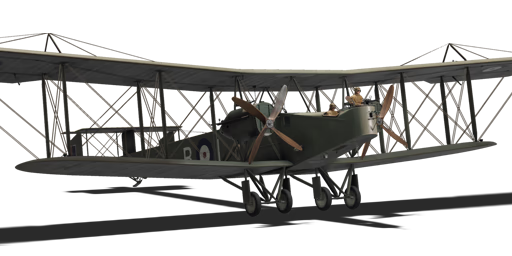
H.P.12

The Handley Page Type O was a British heavy biplane bomber developed during the First World War. The Type O originated from a meeting between Capt. Murray Sueter, the Director of the Air Department of the Royal Navy, and Frederick Handley Page, the owner of the Handley Page company in 1915, during which Sueter requested, in his own words, "a bloody paralyser of an aircraft" to carry as much payload as possible over long distances to perform bombing runs over key targets, especially German ships in their ports. The Type O made its first flight on 17 December 1915 and became the largest airplane in the world at that time. The first variant, designated H.P. 11 (O/100), entered service in 1916. The Type O was deployed extensively throughout the latter half of the Great War, conducting long-range bombing raids and anti-submarine patrols. The second and most produced variant, designated H.P. 12 (O/400), entered service in April 1918 and replaced the H.P. 11 variant. The H.P. 12 featured more powerful Rolls-Royce Eagle VIII engines and the new Drift Sight bomb sight. Due to its capabilities and its sheer size, the Type O left such a strong impression on the British public at that time that "Handley Page" had become a byword for any exceptionally large airplane by the time it was decommissioned in 1922. In total, 600 Type Os of all variants were built, including 554 of the H.P. 12 variant.
The H.P. 12 was introduced during Update "Hornet's Sting" as one of the rewards for the 2025 "The Great War!" event. As one of the first heavy bombers ever built, the H.P. 12’s flight performance is unsurprisingly poor. The plane has an abysmal top speed, climb rate, acceleration and energy retention, and it is not difficult for any fighter to catch up with it. Due to its biplane construction, the H.P. 12 has a very tight turn radius, though any manoeuvre will cause it to lose energy at an alarming rate. While the H.P. 12 features four gunner positions, they are equipped with archaic Lewis machine guns with a very poor rate of fire and coverage. Due to this, along with the plane’s slow speed and huge size, it is very common that enemy pilots who spot it will try to shoot it down. On the bright side, while its bombload of 910 kg is relatively modest compared to more modern bombers, it is still sufficient to deal with bases and ground targets. In addition, the plane can endure a significant amount of hits from the small-calibre machine guns that it usually faces.

flaps
flaps
flaps
brake
control
| Belt | Belt filling | Armor penetration (mm) at a distance: | |||||
|---|---|---|---|---|---|---|---|
| 10 m | 100 m | 500 m | 1000 m | 1500 m | 2000 m | ||
| T/Ball/Ball/Ball/AP | 13 | 12 | 7 | 3 | 2 | 0 | |
| T/AP/AP/AP | 13 | 12 | 7 | 3 | 2 | 0 | |
| T/AP-I/AP-I/AP-I | 13 | 12 | 7 | 3 | 2 | 0 | |



Flight performance | |
|---|---|
Survivability |
|---|
Weaponry | |
|---|---|