As World War II approached, Belgium found itself without an adequate fleet of large ships. The newest ship was the sloop Zinnia, which was completed in 1915. The navy needed a suitable vessel to counter the German small fleet. The new sloop Artevelde was laid down in March 1939. In peacetime, she would have been used to protect fishing operations and serve as a royal yacht. In wartime, she would function as an escort and a minelayer. The sloop was captured by the Germans on May 18, 1940, and was soon renamed the Lorelei. The Germans inspected the ship and continued work on her, launching it on August 28. She was then towed to a suburb of Rotterdam in the Netherlands, where construction continued according to a revised design. Under this design, the Lorelei was to become a Kanonnenboot, and it was renamed K-4. Consequently, the Kanonnenboot was equipped with German 105 mm guns and air defense systems. On April 25, 1943, the ship was commissioned into the Kriegsmarine. K-4 spent most of 1943 undergoing trials and repairs, completing her combat training in the winter. In February 1944 she was assigned to the 1st Mine-Clearing Flotilla, where it escorted convoys. The K-4 underwent repairs again in April.
On July 6, the K-4 was escorting a German convoy along the Elbe–Ems route when it was attacked by several dozen British aircraft. The K-4 shot down one aircraft but was hit several times herself, killing some of the crew members; one of the ships under escort sank. On August 10, the gunboat and her convoy were attacked again, this time by aircraft from the Australian and New Zealand air forces. As a result of the battle, one steamship was sunk, and the enemy lost four aircraft. At the end of August, the K-4 entered dry dock for repairs and resumed operations on September 8. On the night of October 8–9, the sloop and the ships she was escorting were attacked by seven British torpedo boats en route from Borkum to Rotterdam. During the battle, the K-4 got hit several times with autocannons, but, managed to sink one torpedo boat in return. From October through December, the K-4 underwent repairs again. The rest of her service in the Kriegsmarine was uneventful. At the end of the war, the Germans handed the sloop over to the British, who returned her to the Belgians in June 1945. On September 25, the Artevelde was commissioned into the Belgian Navy. As early as February 1946, the sloop was converted into a floating base. From 1950 onward, she served as a floating barracks. On August 23, 1954, the Artevelde was decommissioned, and on November 22, she was sold for scrap. By mid-1955, the ship had been completely scrapped.
The Lorelei was introduced in Update 2.57 "Heavy Cavalry", in its 1944 configuration. It is a typical early bluewater fleet ship with mediocre mobility and survivability, but powerful anti-aircraft defenses.
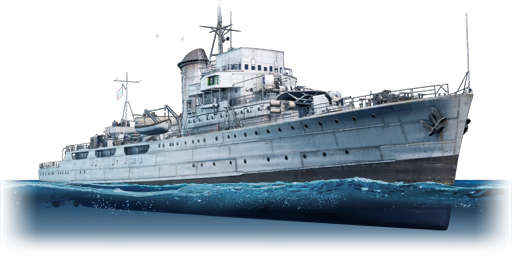





 Lorelei