IRIS-T SLM (TADS)
Basic unit

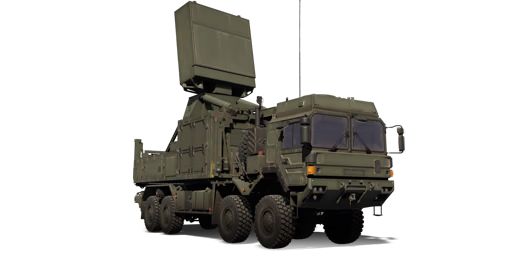




IRIS-T SLM (Infra Red Imaging System — Tail/Thrust Vector-Controlled, Surface Launched Medium Range) is a surface-to-air missile system developed by the German consortium Diehl BGT Defence in cooperation with NATO partners. In December 2005, the German Air Force adopted the IRIS-T air-to-air missile, equipped with an advanced infrared seeker. Later, under the MEADS programme, the IRIS-T SL variant was developed for ground-based launch. This version received a jettisonable nose cone to improve aerodynamics on long-range flights, a new larger-diameter rocket motor, and a navigation system featuring inertial guidance with GPS support and mid-course datalink correction.
In 2015, a short-range air-defence system based on the missile was created, and by 2022, testing of its modernised version — the IRIS-T SLM — was completed. Designed to counter air threats at medium range, the system has a modular structure and can be mounted on a MAN 8×8 wheeled chassis or deployed in a stationary configuration. A typical battery includes a Target Acquisition and Designation System (TADS) equipped with a surveillance and tracking radar, up to four Transporter Erector Launcher (TEL) vehicles carrying missiles, and several support vehicles.
The IRIS-T SLM was introduced in Update 2.47 “Leviathans” as a composite system. It consists of a TADS unit with radar and two TELs with missiles. The TADS unit is lightly armoured and unarmed, making concealment important. If the radar is destroyed, the system is considered disabled. The IRIS-T SL missiles feature infrared, inertial, and datalink guidance, providing high manoeuvrability and effectiveness against a wide range of aerial targets at medium distances.


 IRIS-T SLM (TADS)
Mobility | |
|---|---|
Protection |
|---|
Firepower | |
|---|---|