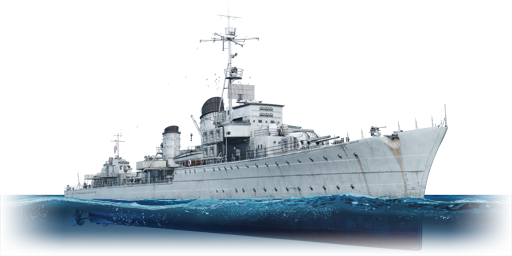
The Z32 was the tenth ship of the 15 Type 1936A Narvik destroyers. The last seven ships, including Z32, belonged to the so-called Mobilisation Series and were therefore built using simplified and cost-effective technologies, hence the prefix "1936A (Mob)" in the ship's designation. They differed from other destroyers by their powerful 150 mm main guns and the resulting larger displacement. Z32 was built by AG Weser in Bremen, laid down on 1 November 1940, launched on 15 August 1941, and commissioned on 15 September 1942.
Initially, she was part of the 6th Destroyer Flotilla and sailed from Kiel to France, where she was primarily tasked with convoy and submarine escort duties, as well as patrol duties. She participated in the Battle of the Bay of Biscay on 28 December 1943. On 30 January 1944, she collided with the destroyer Z37 during an exercise, sustaining severe damage and requiring repairs until May. On 9 June 1944, during the Battle of Ouessant, she was assigned to the 8th Destroyer Flotilla with the mission of attacking and breaking through the D-Day invasion fleet. This mission, however, failed disastrously; the ships of the flotilla turned back after contact with the numerically and technically superior 10th British Destroyer Flotilla or were sunk. Z32, in a duel with HMS Tartar and HMS Ashanti, severely damaged HMS Tartar until she was pursued and heavily damaged by the Canadian destroyers Haida and Huron. After exhausting her ammunition, the captain of Z32 deliberately ran the ship aground at full speed on Île de Batz so that the crew could save themselves. They were later rescued by German patrol boats. The two Canadian destroyers continued firing on Z32, which was later also attacked by Beaufighters. Ultimately, the crew scuttled the ship.
The Z32 was introduced in Update 1.87 "Locked On". The ship is characterised by her high speed and a powerful main battery, which, however, has a long reload time and slow target acquisition.