
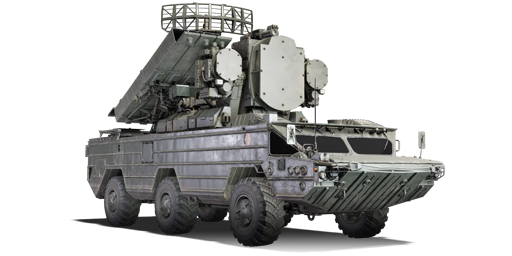
◊Osa-AK




The Osa-AK (9K33M2) is a Soviet mobile surface-to-air missile system, developed by NII-20 in 1973 as an improvement over the base Osa (9K33), and later accepted for service in 1975. This variant would later be followed by the Osa-AKM (9K33M2), which entered service in 1980.
Between 1981–1985, the USSR began delivering 41 Osa-AK systems to East Germany. After German reunification and the integration of the German armed forces, many of the Eastern Bloc systems, including the Osa, were gradually phased out. During this time, 12 of the Osa in German service were sold to Greece, and the rest were scrapped in the early 2000s.
The East German Osa-AK was introduced in Update 2.41 "Firebirds" as a part of the German tech tree. Aside from visual differences, it is functionally identical to its Soviet counterpart. The Osa-AK can reliably engage manoeuvring aerial targets at ranges up to 10 km and is capable of guiding two missiles onto a single target simultaneously. Thanks to its wheeled chassis, the Osa-AK enjoys excellent mobility, allowing it to take up unexpected positions against enemy aircraft. However, the vehicle has a large silhouette, no meaningful armour protection, and its missiles are mounted at an upward angle, leaving it virtually incapable of engaging ground targets.

| Ammunition | Type | Armor penetration (mm) at a distance: | |||||
|---|---|---|---|---|---|---|---|
| 10 m | 100 m | 500 m | 1000 m | 1500 m | 2000 m | ||
| SAM | 60 | 60 | 60 | 60 | 60 | 60 | |


 ◊Osa-AK
Mobility | |
|---|---|
Protection |
|---|
Firepower | |
|---|---|