
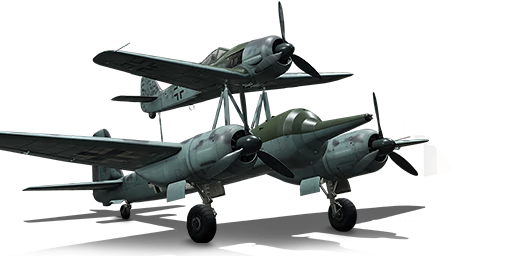
Mistel 2


Mistel (lit. "Mistletoe") was a series of projects to develop composite aircraft for the Luftwaffe in 1942. The project originated from researchers at the German Aircraft Research Institute (DFS), led by Fritz Stamer, who sought to develop a cargo glider carried under a powered aircraft to extend the glider's flight range. This later evolved into a guided weapon system consisting of a smaller piloted aircraft, usually a fighter stripped of its armaments to save weight, mounted onto an unmanned light bomber converted into a flying bomb, with a massive shaped-charge warhead replacing its cockpit and an autopilot to guide it into the target once launched. The intended use of the Mistel was to strike key targets in less-protected areas and allow the pilot to return quickly.
While there were several variants of the Mistel, the Mistel 2 configuration, consisting of a piloted Fw 190 A-8 or G-8 and a converted Ju 88 G-1, was by far the most common, though it saw only limited success. Its first use was during the Battle of Normandy, where it was found to be an easy target for Allied forces. It was later used to destroy key bridges in an attempt to halt Soviet advances in 1945, but the damage only delayed Soviet forces by a few days. In total, at least 250 Mistels of various configurations were built.
The Mistel 2 was introduced as a reward for the 2026 "Dreams Come True" event. The Mistel is the epitome of a "one-trick pony", as its only weapon is a suicide drone converted from a Ju 88 bomber. With the aid of CCIP, the Mistel pilot can launch the drone from a safe distance to deliver a powerful warhead that can even sink a battleship, assuming it doesn't get intercepted. However, being designed for only one task, the Mistel is woefully inadequate in every other aspect; the contraption has awful acceleration and handling, and it is completely defenceless against any other aircraft that can catch up to it.

flaps
flaps
flaps
brake


 2 x (80 / 170 / 290) %
2 x 142 %
Flight performance | |
|---|---|
Survivability |
|---|
