
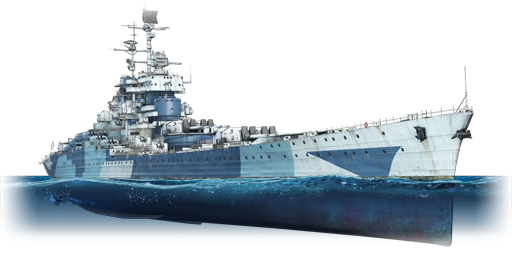
Jean Bart


The Jean Bart was a battleship in the French Navy and the second and final complete ship in the Richelieu class. Construction of the ship began on December 12, 1936, and she was launched on March 6, 1940. The successes of the German forces in the Battle of France prompted the French shipbuilders to prepare the battleship for redeployment to their African colonies. Work on the armament and other systems was postponed in favor of work on the propulsion system. Only the first main battery turret was installed; the secondary battery was absent, and only a pair of twin 90-mm anti-aircraft gun mounts were installed without a fire control system or ammunition. On June 19, the battleship set out to sea and arrived in Casablanca on June 22. En route, she was attacked by German bombers, which inflicted no serious damage. On the same day, the French government signed the surrender, after which the French fleet was attacked by the British forces. Due to these attacks, all open barbettes on the Jean Bart, which was moored in Casablanca and did not house guns, were sealed with concrete plugs, and the battleship's anti-aircraft battery was reinforced. On November 8, 1942, Operation Torch—the Allied invasion of French North Africa—began. A large American naval force led by the battleship USS Massachusetts approached Casablanca.
During the battle, the Jean Bart was hit several times, began to flood, and its main battery turret jammed. However, the ship remained combat-ready, and the turret was repaired. A 406 mm shell fired from the Massachusetts exploded in the Jean Bart's 152 mm magazines. This would have inevitably destroyed the battleship if the shells had been there. On November 11, the Casablanca garrison surrendered to the Allies and defected to the Free French. By February 15, 1943, the Jean Bart was ready for sea. An agreement was reached with the United States to repair and complete the ship in America. However, the proposed completion plans were rejected by the Americans. As a result, the battleship remained in Casablanca and was used as a training ship until the end of the war.
After the war, the Jean Bart returned to France and was finally completed and repaired by the end of 1948. She participated in the Suez Crisis later that year and was transferred to reserve in 1957. Although various options for modernizing the battleship with missiles were considered, they were not implemented. The ship was converted into a floating barracks and remained inactive until 1970. She was decommissioned on February 10, 1970, and scrapped on May 21.
The Jean Bart was introduced in Update 2.57 "Heavy Cavalry" in her 1955 modification. The battleship has excellent secondary armaments and a powerful anti-aircraft (AA) battery complemented by radar. She also offers decent protection. However, its 380mm main guns are relatively weak, and the turrets of the main caliber are only located in the bow. This results in a very narrow firing arc.

| Ammunition | Type | Armor penetration (mm) at a distance: | |||||
|---|---|---|---|---|---|---|---|
| 1000 m | 2500 m | 5000 m | 7500 m | 10000 m | 15000 m | ||
| HE | 112 | 107 | 100 | 93 | 86 | 74 | |
| APCBC | 712 | 681 | 633 | 588 | 547 | 471 | |
| APCBC | 741 | 709 | 659 | 613 | 570 | 491 | |
| Ammunition | Type | Armor penetration (mm) at a distance: | |||||
|---|---|---|---|---|---|---|---|
| 1000 m | 2500 m | 5000 m | 7500 m | 10000 m | 15000 m | ||
| HE | 42 | 42 | 42 | 42 | 42 | 42 | |
| SAPCBC | 138 | 120 | 93 | 70 | 52 | 39 | |
| APCBC | 312 | 277 | 226 | 182 | 144 | 95 | |
| HE-TF | 42 | 42 | 42 | 42 | 42 | 42 | |
| Ammunition | Type | Armor penetration (mm) at a distance: | |||||
|---|---|---|---|---|---|---|---|
| 100 m | 1000 m | 2000 m | 3000 m | 4000 m | 5000 m | ||
| HE-TF | 22 | 19 | 16 | 15 | 15 | 15 | |
| Ammunition | Type | Armor penetration (mm) at a distance: | |||||
|---|---|---|---|---|---|---|---|
| 100 m | 1000 m | 2000 m | 3000 m | 4000 m | 5000 m | ||
| HEF-I | 9 | 8 | 7 | 7 | 7 | 7 | |


 2 x (450 / 600) %
2 x 232 %
2 x (450 / 600) %
2 x 232 %
Seakeeping |
|---|
Unsinkability | |
|---|---|
Firepower | ||
|---|---|---|