The Clemenceau was the third battleship of the Richelieu class and was named after Georges Clemenceau, a former prime minister of France. Laid down on January 17, 1939, in Brest, it was never completed. It was scheduled to launch in 1941 and be finished by 1943, but the war intervened. In September 1939, most of the shipyard workers left for the front. Those who remained were transferred to finish the nearly completed Richelieu. Work on the Clemenceau was put on hold. Work resumed in December, but progress was slow. On June 10, 1940, construction of the battleship was suspended again. When German troops captured Brest, shipyard workers flooded the dry dock where the Clemenceau was under construction. After the Germans took control, they named the hull Schlachtschiff R and even planned to finish the ship. Ultimately, however, these plans never materialized.
In 1941, the hull was raised and, according to some sources, moored in Brest, although other historians claim it was towed to Ladevennec. On August 27, 1944, the hull sank again during an Allied air raid. In 1948, a proposal was made to sell the hull, but no one wanted it. The Navy raised it to the surface but, while attempting to tow it to the shipyard, the hull broke in two and sank. Consequently, it was not until 1951 that the hull was purchased and gradually raised for sale as scrap metal.
The Clemenceau was introduced in Update 2.51 "Spearhead" in its planned configuration. The battleship has decent main-caliber guns and fairly serious armor. It also has a good battery of secondary-caliber guns and long-range anti-aircraft guns. However, it has very little small-caliber anti-aircraft artillery, and its mobility is average.
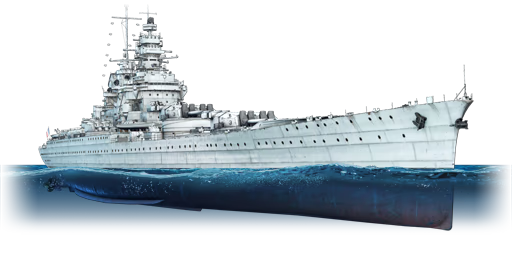



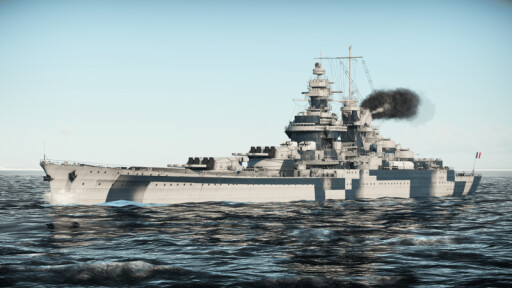



 Clemenceau