
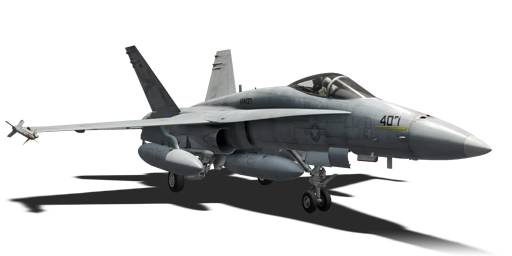
F/A-18A



The F/A-18A is a fourth-generation American all-weather multirole fighter that spawned a large family of aircraft for the U.S. Navy. It originated from the Light Weight Fighter (LWF) competition, in which its predecessor, the YF-17, lost to the YF-16. Consequently, the project nearly ended. However, the U.S. Navy needed a new fighter to replace the aging F-4 and A-7. The Navy had already designed simplified versions of the F-14 and F-15, but they were too expensive. Therefore, the Navy turned its attention to the twin-engine aircraft from the Air Force’s LWF program. However, the F-16 was not considered due to its fragile landing gear design and single engine.
In 1975, the Navy selected the YF-17 design. After a series of modifications, it was designated the F-18. Since Northrop, the original developer of the YF-17, had no experience building carrier-based aircraft, the redesign became a joint effort with McDonnell Douglas. Northrop soon withdrew from the project entirely for legal reasons. The plan was to procure 780 aircraft in three variants: the single-seat F-18A fighter, the two-seat A-18A attack aircraft with different avionics, and the two-seat TF-18A with a reduced fuel capacity. Subsequently, the A-18A and the F-18A were combined into a single aircraft: the F/A-18A.
The F/A-18A first saw combat during Operation El Dorado Canyon against Libya in April 1986, when it was tasked with countering air defenses. During the Gulf War of 1991, the U.S. Navy deployed 106 F/A-18A/C fighters, and the Marine Corps deployed 84 F/A-18A/C/Ds. The F/A-18 has been exported to Australia, Spain, Canada, and other countries. Most F/A-18As were later upgraded to the F/A-18C model.
The F/A-18A was introduced in Update 2.45 "Hornet's Sting. Thanks to a wide range of weapons and new IR-guided bombs, the aircraft possesses truly versatile capabilities in both air combat and ground attack. Compared to other American fighters, the F/A-18 boasts outstanding maneuverability, partly due to its ability to "disable limits". However, the aircraft has several drawbacks, including a limited amount of countermeasures, slow speed compared to other fourth-generation fighters, and a lack of modern guided weapons.

flaps
flaps
flaps
brake
| Belt | Belt filling | Armor penetration (mm) at a distance: | |||||
|---|---|---|---|---|---|---|---|
| 10 m | 100 m | 500 m | 1000 m | 1500 m | 2000 m | ||
| HEF-I/API-T/AP-I/SAPHEI | 40 | 36 | 21 | 11 | 6 | 3 | |
| HEF-I/HEF-I/API-T/HEF-I/HEF-I/AP-I | 40 | 36 | 21 | 11 | 6 | 3 | |
| HEF-I/AP-I/AP-I/SAPHEI | 40 | 36 | 21 | 11 | 6 | 3 | |
| SAPHEI | 37 | 33 | 20 | 11 | 6 | 4 | |
| Name | Weight | Slot | ||||||||
|---|---|---|---|---|---|---|---|---|---|---|
| 84.5 kg |  | | ||||||||
| 2 × | 168.9 kg |  | | |||||||
| 231.3 kg |  | | | | ||||||
| 231.3 kg |  | | | | ||||||
| 38 × | 512.3 kg | 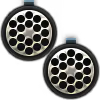 | | | | |||||
| 8 × | 560.6 kg |  | | | | |||||
| 240.9 kg |  | | | | | |||||
| 2 × | 481.8 kg |  | | | | | ||||
| 446.8 kg |  | | | | | |||||
| 2 × | 893.6 kg |  | | | | |||||
| 893.6 kg |  | | | | ||||||
| 254 kg |  | | | | | |||||
| 2 × | 508 kg |  | | | | | ||||
| 446.8 kg |  | | | | | |||||
| 2 × | 893.6 kg |  | | | | |||||
| 235.9 kg |  | | | | | |||||
| 2 × | 471.8 kg |  | | | | |||||
| 1,061.4 kg |  | | ||||||||
| 362.9 kg |  | | | | ||||||
| 549.1 kg |  | | | | ||||||
| Drop tank (330 gal.) | 110 kg |  | | | ||||||
| AN/AAS-38 optical pod | 158 kg |  | ||||||||


Flight performance | |
|---|---|
Survivability |
|---|
Weaponry | ||
|---|---|---|