

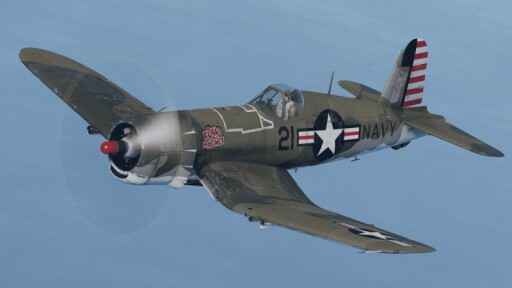
F4U-4B


In 1944, the American company Vought was working on a significant upgrade to its aging F4U-1s. The designers selected the F4U-1A(/unit/f4u-1a/) for this purpose. They replaced the engine with a more powerful R-2800-18W Double Wasp featuring water-ethanol injection. They also removed the unprotected fuel tanks from the wings to increase maneuverability and installed a new air intake under the nose. The propeller was also replaced with a four-bladed model. The suspended and offensive armament were made identical to those of the F4U-1D. Deliveries of the new carrier-based fighter, the F4U-4, began in February 1945 and continued until 1947. A total of 2,357 aircraft were built.
Based on this model, a version with four 20-mm cannons was developed and designated the F4U-4B. The "B" denotes the inclusion of special armament from an earlier version. A total of 297 aircraft of this variant were built. Like other American Corsairs, these aircraft remained in service with the U.S. Navy and the U.S. Marine Corps until 1952, when they were replaced by jet aircraft.
The F4U-4B was introduced in Update 1.71 "New E.R.A.". It is a fast fighter with excellent roll performance, good offensive and suspended armament. However, its WEP duration is limited, and its maneuverability is poor at low speeds. At high speeds, the control becomes unresponsive, making it difficult to aim. It differs from the F4U-4 in that it has a slightly more powerful engine and enhanced armament.

flaps
flaps
flaps
brake
| Belt | Belt filling | Armor penetration (mm) at a distance: | |||||
|---|---|---|---|---|---|---|---|
| 10 m | 100 m | 500 m | 1000 m | 1500 m | 2000 m | ||
| HEF-I/AP-T | 36 | 33 | 23 | 15 | 9 | 6 | |
| AP-T/AP-T/HEF-I/HEF-I | 36 | 33 | 23 | 15 | 9 | 6 | |
| HEF-I/HEF-I/HEF-I/AP-T | 36 | 33 | 23 | 15 | 9 | 6 | |
| AP-T/AP-T/AP-T/HEF-I | 36 | 33 | 23 | 15 | 9 | 6 | |
| HEF-I | 5 | 4 | 3 | 2 | 2 | 2 | |
| Name | Weight | Slot | ||||||||||
|---|---|---|---|---|---|---|---|---|---|---|---|---|
| 62.8 kg |  | | | | | | | | ||||
| 117.9 kg |  | | | | ||||||||
| 534.2 kg |  | | ||||||||||
| 242.6 kg |  | | ||||||||||
| 500.8 kg |  | | ||||||||||


 F4U-4B
Flight performance | |
|---|---|
Survivability |
|---|
Weaponry | |
|---|---|
