
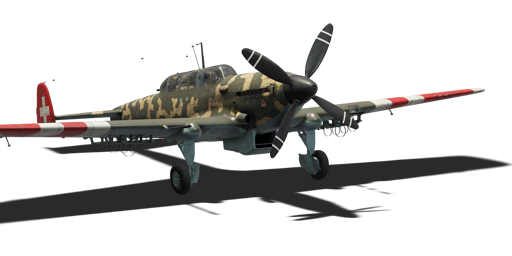
◌C-3604




As Switzerland maintained a strict neutrality policy, the Swiss government recognised the importance of maintaining well-equipped and self-sufficient armed forces to serve as a deterrent against potential incursions. One example of this is the EKW C-36, a domestic ground attack aircraft developed in 1935 by the state-owned arms manufacturer EKW to replace the Fokker C.V-E biplanes. Although the Swiss Air Force considered purchasing German Bf 110 or French Potez 63 attackers, a decision was made to proceed with the C-36 after bids for both aircraft failed. The first prototype, designated C-3601, made its maiden flight on 15 May 1939. It was further refined into the C-3603, the main serial production model that entered service in 1942, featuring retractable undercarriage and a single 20 mm Oerlikon autocannon mounted in the propeller hub. During World War II, the C-36s were deployed to repel trespassing aircraft to defend Swiss neutrality, though due to its low top speed, it was relegated to training and target-towing duties. In total, 175 C-36s of all variants were built, and would be fully retired from the Swiss Air Force in 1988.
The C-3604 was an upgraded variant of the C-3603. It featured a more powerful engine and two additional 20 mm Hispano-Suiza cannons in its wings to supplement the one mounted in the nose. In total, 13 C-3604s (including the prototype) were built.
Introduced in Update "Leviathans", the C-3604 is remarkably similar to the Soviet IL-2 series, featuring powerful offensive armaments, decent survivability, and a surprisingly good turn radius. The three Hispano autocannons are quite versatile, as they can be effectively used against both air and ground targets. However, the C-3604 has limited energy retention, top speed, climb rate, and mediocre defensive armaments, which can be easily exploited by opponents in bringing it down.

flaps
flaps
flaps
brake
| Belt | Belt filling | Armor penetration (mm) at a distance: | |||||
|---|---|---|---|---|---|---|---|
| 10 m | 100 m | 500 m | 1000 m | 1500 m | 2000 m | ||
| HEF/HEF-I/HEF-T/AP-I | 41 | 38 | 27 | 18 | 12 | 8 | |
| AP-T/HEF | 41 | 38 | 27 | 17 | 11 | 7 | |
| AP-T/AP-I/AP-T/HEF | 41 | 38 | 27 | 18 | 12 | 8 | |
| AP-T/HEF/HEF-T/AP-T/HEF-I | 41 | 38 | 27 | 17 | 11 | 7 | |
| AP-T/HEF-T | 41 | 38 | 27 | 17 | 11 | 7 | |
| AP-I/HEF | 41 | 38 | 27 | 18 | 12 | 8 | |
| Belt | Belt filling | Armor penetration (mm) at a distance: | |||||
|---|---|---|---|---|---|---|---|
| 10 m | 100 m | 500 m | 1000 m | 1500 m | 2000 m | ||
| HEF/HEF-I/HEF-T/AP-I | 39 | 36 | 26 | 17 | 12 | 8 | |
| AP-T/HEF | 39 | 36 | 26 | 17 | 11 | 7 | |
| AP-T/AP-I/AP-T/HEF | 39 | 36 | 26 | 17 | 12 | 8 | |
| AP-T/HEF/HEF-T/AP-T/HEF-I | 39 | 36 | 26 | 17 | 11 | 7 | |
| AP-T/HEF-T | 39 | 36 | 26 | 17 | 11 | 7 | |
| AP-I/HEF | 39 | 36 | 26 | 17 | 12 | 8 | |
| Belt | Belt filling | Armor penetration (mm) at a distance: | |||||
|---|---|---|---|---|---|---|---|
| 10 m | 100 m | 500 m | 1000 m | 1500 m | 2000 m | ||
| T/Ball/AP | 13 | 12 | 7 | 3 | 2 | 0 | |
| T/AP | 13 | 12 | 7 | 3 | 2 | 0 | |
| T | 5 | 4 | 2 | 1 | 0 | 0 | |
| AP | 13 | 12 | 7 | 3 | 2 | 0 | |
| Belt | Belt filling | Armor penetration (mm) at a distance: | |||||
|---|---|---|---|---|---|---|---|
| 10 m | 100 m | 500 m | 1000 m | 1500 m | 2000 m | ||
| T/Ball/AP | 13 | 12 | 7 | 3 | 2 | 0 | |
| T/AP/AP/AP/AP | 13 | 12 | 7 | 3 | 2 | 0 | |
| T/AP/T/AP | 13 | 12 | 7 | 3 | 2 | 0 | |
| Name | Weight | Slot | ||||||
|---|---|---|---|---|---|---|---|---|
| 8 × | 182.7 kg |  | | |||||
| 4 × | 200 kg |  | | |||||
| 200 kg |  | | ||||||


Flight performance | |
|---|---|
Weaponry | ||
|---|---|---|