Alpha Jet E



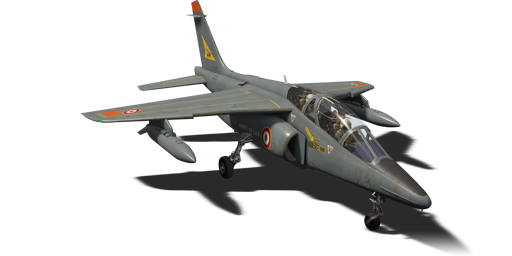
The Alpha Jet E is a light training aircraft that was jointly developed by the German company Dornier and the French company Dassault-Breguet. In the 1960s, European air forces became interested in developing a new combat training aircraft. France and West Germany held discussions that resulted in joint specifications for such an aircraft, envisioning two versions: a training aircraft for France and an attack aircraft for Germany. Several companies entered the competition, including VFW-Fokker, SNIAS/MBB, and Breguet-Dassault-Dornier with its TA501. The TA501 was selected as the winner in July 1970. The design was finalized in February 1971, and an order for four prototypes was placed in Bordeaux. The first flight of the French prototype occurred in October 1973 and the German prototype in January 1974. Tests of both aircraft versions were conducted in the same year. Due to their different avionics systems, the French and German Alpha Jets can be easily distinguished visually: French aircraft have a rounded nose, while German aircraft have a sharp, pointed nose. Between December 1978 and July 1990, the French Air Force received 176 Alpha Jet E aircraft, comprising 58% of the 303 units produced. These aircraft replaced the outdated T-33, Fouga Magister, and Mystère IV for training. Today, 75 upgraded Alpha Jet E aircraft remain in training squadrons. The French training version of the Alpha Jet was also exported to Egypt, Morocco, Qatar, and Nigeria.
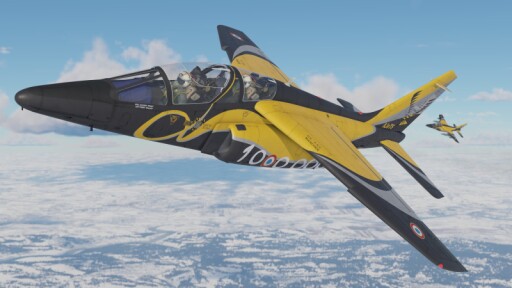
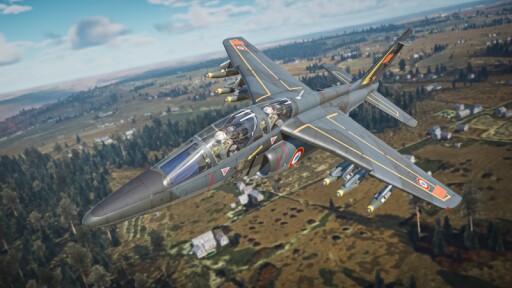
The Alpha Jet E was introduced in Update 2.35 "Alpha Strike". It is a light, compact, and maneuverable aircraft with a wide selection of drop weapons. Its best use is in mixed battles, but thanks to its small size, excellent handling, and good cannon, the aircraft will also find use in air modes. Although the Alpha Jet E has no guided weapons, it has a ballistic computer for missiles and bombs, allowing it to effectively engage ground targets from low altitudes. Its main armament is a 30mm DEFA 553 cannon awkwardly mounted under the fuselage. It has excellent ballistics and causes significant damage to aircraft. Additionally, unlike the German version, two additional containers with cannons can be suspended. Negative aspects of the aircraft include the lack of an RWR and countermeasures, as well as poor acceleration above 700 km/h.

flaps
flaps
flaps
brake
| Name | Weight | Slot | ||||
|---|---|---|---|---|---|---|
| 247 kg |  | | | | ||
| 264 kg |  | | | | ||
| 240.9 kg |  | | | | ||
| 254 kg |  | | | | ||
| 310.7 kg |  | | | | ||
| 18 × | 183.9 kg |  | | | | |
| 36 × | 181.8 kg |  | | | | |
| Drop tank (310 liters) | 120 kg |  | | |||
| 2 × | 481.8 kg |  | | |||
| 2 × | 508 kg |  | | |||
| 2 × | 494 kg |  | | |||
| 2 × | 528 kg |  | | |||
| 126.3 kg |  | | ||||
| 330.8 kg |  | |||||


Flight performance | |
|---|---|
Survivability |
|---|
Weaponry | ||
|---|---|---|