
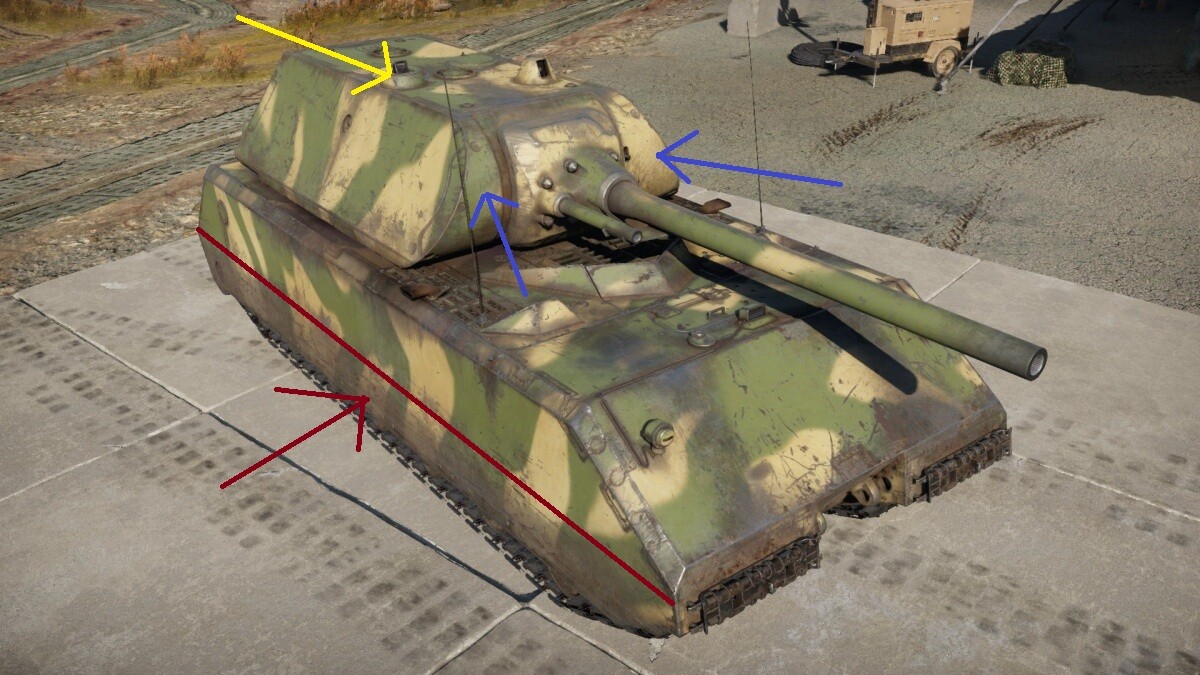
The Maus has some weak spots, as shown in the picture. First, the lower section of the side skirts, marked in red, can be penetrated by high powered AP rounds, though generally only from directly side on. The turret cheeks can be penetrated by more powerful HEAT, APCR and APDS rounds, as well as some particularly powerful full caliber AP rounds. Third, a 155mm HE round to the commander's periscope, marked in yellow, will overpressure the crew compartment for a one shot kill.
The missiles that the ADATS carries are beam riding, as opposed to the SACLOS guidance common among other missile based SPAA of a similar battle rating. This has a unique advantage in that your missiles will not set off an enemy aircraft's RWR. That, combined with the IRST-only target tracking on the ADATS, means that the entire engagement process can be carried out without alerting the enemy aircraft.
The ADATS does not have a tracking radar. It only uses IRST for target tracking. While this does have the benefit of not alerting enemy planes, it also means that you can not lock on to targets in third person view. Additionally, target tracking can be rather spotty at ranges beyond about 5 km, especially against smaller targets like drones and helicopters.