
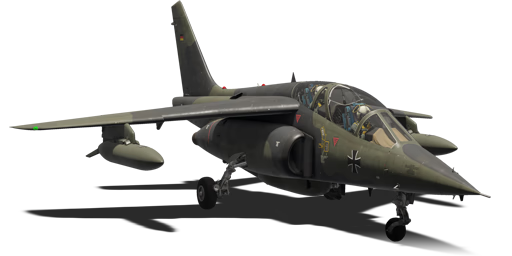




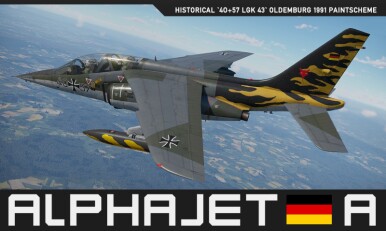
The Alpha Jet A is a light training aircraft that was jointly developed by the German company Dornier and the French company Dassault-Breguet. In the 1960s, European air forces became interested in developing a new combat training aircraft. France and West Germany held discussions that resulted in joint specifications for such an aircraft, envisioning two versions: a training aircraft for France and an attack aircraft for Germany. Several companies entered the competition, including VFW-Fokker, SNIAS/MBB, and Breguet-Dassault-Dornier with its TA501. The TA501 was selected as the winner in July 1970. The design was finalized in February 1971, and an order for four prototypes was placed in Bordeaux. The first flight of the French prototype occurred in October 1973 and the German prototype in January 1974. Tests of both aircraft versions were conducted in the same year. Due to their different avionics systems, the French and German Alpha Jets can be easily distinguished visually: French aircraft have a rounded nose, while German aircraft have a sharp, pointed nose. The Luftwaffe decided to use the Alpha Jet primarily as a light attack aircraft and to continue flight training in the United States with American trainers. The first German Alpha Jet production aircraft made its maiden flight on April 12, 1978, and the first deliveries to the armed forces began in March 1979. It was designated the Alpha Jet A ("A" stands for appui tactique, or "tactical support"). By 1983, the Luftwaffe had purchased 175 Alpha Jet As to replace its fleet of Fiat G.91R/3s. Despite modernization attempts, the Alpha Jet A was withdrawn from German service in 1992, with some aircraft transferred to Portugal.
The Alpha Jet A was introduced in Update 2.35 "Alpha Strike". It is a light, compact, and maneuverable aircraft with a wide selection of external weapons. It is best suited for mixed combat, but its small size, excellent maneuverability, and good cannon also make it suitable for air-to-air combat. Although the Alpha Jet A lacks guided weapons, it has a ballistic computer for missiles and bombs, enabling it to engage ground targets effectively from low altitudes. Additionally, unlike the French version, armament consists of a 27 mm Mauser BK27 cannon mounted awkwardly under the fuselage, but it has good ballistics and deals high damage to aircraft. Moreover, the Alpha Jet A is equipped with countermeasures which significantly improve its survivability in air and mixed battles by protecting it from IR missiles. Negative aspects of the aircraft include the lack of an RWR and poor acceleration above 700 km/h.

flaps
flaps
flaps
brake
| Name | Weight | Slot | ||||
|---|---|---|---|---|---|---|
| 247 kg |  | | | | ||
| 264 kg |  | | | | ||
| 240.9 kg |  | | | | ||
| 254 kg |  | | | | ||
| 310.7 kg |  | | | | ||
| 19 × | 233.7 kg |  | | | | |
| Drop tank (310 liters) | 120 kg |  | | |||
| 2 × | 481.8 kg |  | | |||
| 2 × | 508 kg |  | | |||
| 2 × | 494 kg |  | | |||
| 2 × | 528 kg |  | | |||
| 38 × | 467.5 kg |  | | |||
| 351 kg |  | |||||


Flight performance | |
|---|---|
Survivability |
|---|
Weaponry | |
|---|---|