
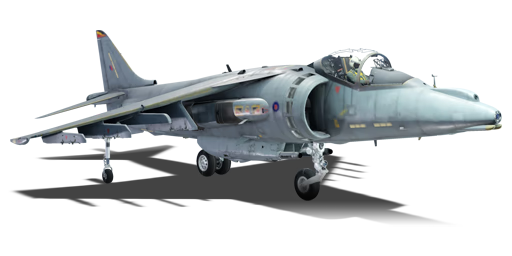



After operating the early Harrier GR.1 and GR.3 models, the British military decided that the aircraft needed an increased combat payload, modern avionics, and the capability to operate effectively at night and in all weather conditions. At that time, McDonnell Douglas was developing the AV-8B Harrier II for the U.S. Marine Corps, and the UK joined the program. The British variant, the Harrier GR.5, featured a new composite wing with an increased surface area, a redesigned fuselage, and a more powerful Rolls-Royce Pegasus engine.
The new Harriers began entering service with the UK in 1987, and by 1989, British aircraft carriers were fully prepared to operate them. However, even while the GR.5 was in service, it became clear that the aircraft required further modernization. This led to the Harrier GR.7, which made its first flight in 1989. An evolution of the GR.5, the aircraft gained the capability to use Paveway guided bombs, FLIR, digital terrain mapping, and support for the pilot’s night vision goggles. Later, virtually all early GR.5s were upgraded to the GR.7 standard. The aircraft was used in operations in the Balkans, Iraq, and Afghanistan and was phased out in late 2010 in favor of the F-35B.
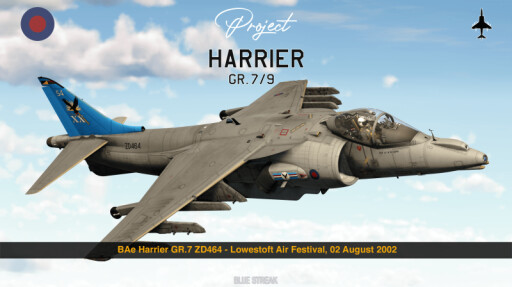
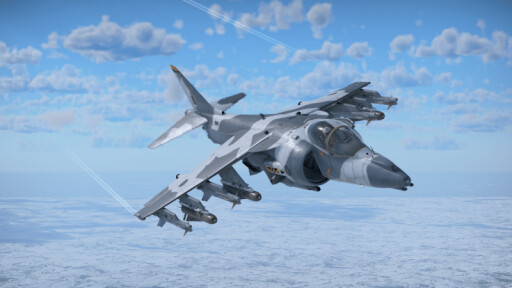
The Harrier GR.7 was introduced in Update 2.19 "Drone Age". Compared to base Harrier models, the GR.7 has a new Rolls-Royce Pegasus engine that increases its speed. The attack aircraft is also equipped with advanced armaments, including Paveway II/III guided bombs, AGM-65 Maverick missiles, and AIM-9M air-to-air missiles for engaging aerial targets. Despite its advantages, it is worth noting its insufficient maneuverability and limited number of air-to-air missiles.

flaps
flaps
flaps
brake
| Name | Weight | Slot | ||||||||||
|---|---|---|---|---|---|---|---|---|---|---|---|---|
| 84.5 kg |  | | | | ||||||||
| 160 × Countermeasures (BOL) | 39.4 kg |  | | | | |||||||
| 160 × Countermeasures (BOL) | 123.9 kg |  | | | | |||||||
| 84.5 kg |  | | | | ||||||||
| 160 × Countermeasures (BOL) | 123.9 kg |  | | | | |||||||
| 19 × | 263.9 kg |  | | | | | | |||||
| 18 × | 183.9 kg |  | | | | | | |||||
| 213.1 kg |  | | | | | | | |||||
| 295 kg |  | | | | | | | |||||
| 277.1 kg |  | | | | | | ||||||
| 216 × Large caliber chaff countermeasures | 216.1 kg | | ||||||||||
| 226.8 kg |  | | | | ||||||||
| 303.5 kg |  | | | | ||||||||
| 291.2 kg |  | | | | ||||||||
| 486 kg |  | | | | | |||||||
| 486 kg |  | | | | | |||||||
| 546.5 kg |  | | | | ||||||||
| 546.5 kg |  | | | | ||||||||
| 1,079.6 kg |  | | ||||||||||
| 151.9 kg |  | | ||||||||||
| TIALD targeting pod | 120 kg |  | ||||||||||


 Harrier GR.7
Flight performance |
|---|
Survivability |
|---|
Weaponry | |||||
|---|---|---|---|---|---|