
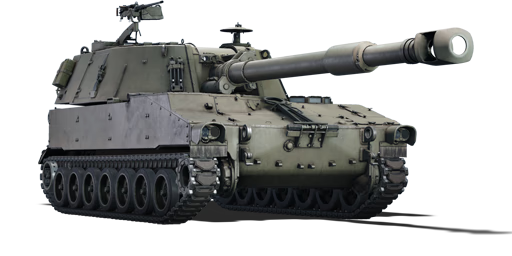



The M109A1 is an updated version of the American M109 self-propelled howitzer. Developed in the early 1950s, the M109 replaced early post-war self-propelled howitzers, such as the 155mm M44 and the 105mm M52. The M109 entered production in 1963 and entered service in the same year. By 1966, it had seen combat in the Vietnam War, where significant technical shortcomings of the early models were revealed.
A new modification, the M109A1, appeared in 1973. Its main improvements included a longer barrel, reinforced suspension, and upgraded turret drives. Following these upgrades, the M109A1 became the U.S. Army's primary self-propelled howitzer for decades and participated in nearly all ground operations. In 1965, the United Kingdom purchased 140 M109s from the U.S., upgraded them to the A1 standard, and sold them to Austria in 1994.
The British M109A1 was introduced in Update 2.31 "Kings of Battle". Compared to the earlier M109s, the M109A1's longer barrel provides higher projectile velocity, making direct fire from the powerful gun easier. But the new cannon did not solve the other problems, and like most self-propelled artillery, the M109's armor cannot withstand anti-tank shells and only protects against machine gun fire and shell fragments.

| Ammunition | Type | Armor penetration (mm) at a distance: | |||||
|---|---|---|---|---|---|---|---|
| 10 m | 100 m | 500 m | 1000 m | 1500 m | 2000 m | ||
| HE | 61 | 61 | 61 | 61 | 61 | 61 | |
| Smoke | 5 | 5 | 5 | 5 | 5 | 5 | |
| HE-VT | 61 | 61 | 61 | 61 | 61 | 61 | |
| Belt | Belt filling | Armor penetration (mm) at a distance: | |||||
|---|---|---|---|---|---|---|---|
| 10 m | 100 m | 500 m | 1000 m | 1500 m | 2000 m | ||
| API-T/I/AP/API-T | 31 | 29 | 21 | 14 | 9 | 6 | |


 ▄M109A1
Mobility | |
|---|---|
Protection |
|---|
Firepower | |
|---|---|