
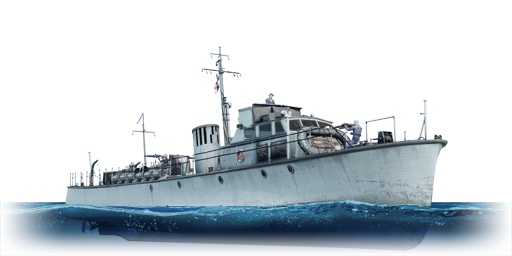



Recognizing the growing threat of war and the Royal Navy’s lack of suitable means to counter German submarines at the beginning of 1939, Fairmile Marine independently developed the wooden patrol boat project, Fairmile A. Its design made extensive use of prefabricated components that could be manufactured by a large number of small companies, allowing for rapid, large-scale production. Initially, however, the project was not approved by the British Admiralty. Despite this, Fairmile continued working on the project privately and completed the first boat, designated ML100, by May 19, 1940.
When war broke out, the Admiralty reconsidered the project, purchasing the unfinished ML100 and ordering 24 more boats. The series was intended for coastal escort, minesweeping, and anti-submarine operations. However, the Admiralty did not specify how the boats were to be armed. Consequently, the vessels lacked proper deck mountings and could not be fitted with heavy guns. Based on their intended roles, the boats were not expected to engage in artillery combat. The Royal Navy equipped the boats with whatever was available from World War I. The standard armament became three twin 7.7-millimeter Lewis machine guns and a 47-millimeter Hotchkiss gun mounted aft. Besides the armament issues, the series suffered from poor handling and seaworthiness. This led to an order reduction to 12 units, with production shifting to the more successful Fairmile B. After the war, the surviving Fairmile A boats were quickly retired. ML100 was decommissioned in October 1947 and sold.
The Fairmile A (ML100) was introduced in Update 1.83 "Masters of the Sea". The ship has decent speed and maneuverability, but weak armament and a small crew.

| Ammunition | Type | Armor penetration (mm) at a distance: | |||||
|---|---|---|---|---|---|---|---|
| 100 m | 1000 m | 2000 m | 3000 m | 4000 m | 5000 m | ||
| HE | 4 | 4 | 4 | 4 | 4 | 4 | |
| Belt | Belt filling | Armor penetration (mm) at a distance: | |||||
|---|---|---|---|---|---|---|---|
| 10 m | 100 m | 500 m | 1000 m | 1500 m | 2000 m | ||
| AP/T/AP/T | 10 | 9 | 8 | 7 | 6 | 5 | |
| AP/AP/AP/T | 10 | 9 | 8 | 7 | 6 | 5 | |
| IT/IT/IT/IT | 10 | 9 | 7 | 6 | 5 | 5 | |