
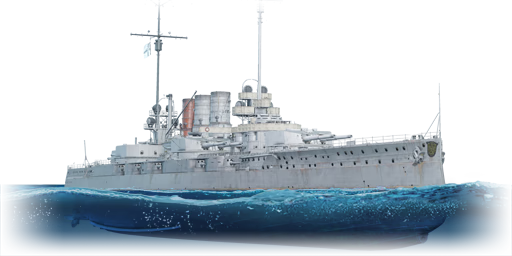


The SMS Ostfriesland was the lead ship of the Ostfriesland class of dreadnoughts in the Imperial German Navy, which was sometimes referred to as the Helgoland class. These ships were similar to their Nassau predecessors in many respects. They had the same armament layout and virtually identical propulsion systems (steam engines). However, there were also significant differences. The armor and structural underwater protection were reinforced. The main caliber consisted of twelve 305 mm guns instead of the Nassau class' 283 mm guns. The displacement increased by 4,000 tons. Overall, the Ostfriesland class was a logical, albeit mild, development of the Nassau class ships.
The ship was laid down on October 19, 1908; launched on September 30, 1909; and entered service on August 1, 1911. During World War I, Ostfriesland and other ships in the series were part of the Kaiserliche Marine's High Seas Fleet and actively participated in battles. It took part in the Battle of Heligoland Bight, the Battle of Dogger Bank—though the battleships did not arrive in time—and the Battle of Jutland. It also participated in the blockade of the Gulf of Riga. After the war, the United States received the ship as reparations, and it crossed the Atlantic. American designers then studied the ship. It was then reclassified as a target ship and sunk during a training air raid.
The SMS Ostfriesland was introduced as one of the rewards for the 2022 Project "Overpowered" event and is depicted in its 1911 state. It is a typical example of the first generation of dreadnoughts: slow-moving and lacking air defense. It is characterized by limited angles of fire from its side turrets but is well-protected, including against torpedo attacks.

| Ammunition | Type | Armor penetration (mm) at a distance: | |||||
|---|---|---|---|---|---|---|---|
| 1000 m | 2500 m | 5000 m | 7500 m | 10000 m | 15000 m | ||
| HE | 170 | 154 | 132 | 113 | 96 | 72 | |
| SAP | 487 | 443 | 378 | 323 | 277 | 206 | |
| APC | 525 | 476 | 405 | 345 | 294 | 217 | |
| Ammunition | Type | Armor penetration (mm) at a distance: | |||||
|---|---|---|---|---|---|---|---|
| 1000 m | 2500 m | 5000 m | 7500 m | 10000 m | 15000 m | ||
| HE | 33 | 29 | 23 | 21 | 21 | 21 | |
| SAPBC | 93 | 76 | 52 | 35 | 27 | 25 | |
| APCBC | 235 | 192 | 132 | 89 | 67 | 64 | |
| Ammunition | Type | Armor penetration (mm) at a distance: | |||||
|---|---|---|---|---|---|---|---|
| 100 m | 1000 m | 2000 m | 3000 m | 4000 m | 5000 m | ||
| HE-TF | 18 | 18 | 18 | 18 | 18 | 18 | |



Seakeeping |
|---|
Unsinkability | |
|---|---|
Firepower | ||
|---|---|---|