
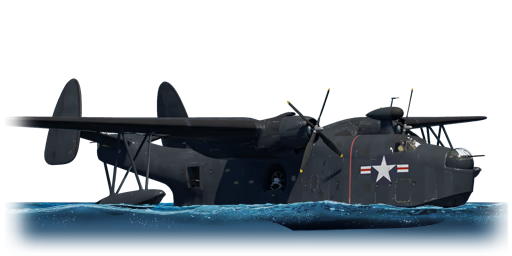


The Martin PBM-5 Mariner was the most widely produced variant of the American PBM flying boat. Early versions of this aircraft had modest performance, but Martin engineers worked hard to improve it. The first attempt at a significant performance upgrade was the PBM-4, which was supposed to be equipped with Wright R-3350-8 Duplex-Cyclone engines. However, these engines were not fully developed when the project began, and they were earmarked for the B-29 Superfortress bomber. Consequently, the designers settled for the slightly less powerful Pratt & Whitney R-2800-34 Double Wasp engines. The version equipped with these engines became known as the PBM-5. In May 1943, two PBM-5 prototypes entered testing. By January 3, 1944, Martin had received a large order for 1,000 PBM-5s, though the order was reduced after the war ended. By July 1947, a total of 614 PBM-5s had been produced, and they were used by the U.S. Navy during World War II and the Korean War for anti-submarine, patrol, and search-and-rescue missions.
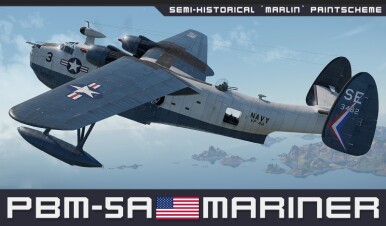
In addition to the basic PBM-5, there were several specialized versions of the flying boat, including the PBM-5A, an amphibious aircraft equipped with retractable landing gear and new propellers. From December 1947 to March 1949, 36 PBM-5As were produced, and four were converted from unfinished PBM-5s. These flying boats remained in service with the U.S. Navy until July 1956. In 1955, another 17 were purchased for the Royal Netherlands Navy’s naval aviation. However, the PBM-5As did not remain in service with the Dutch for long: due to numerous technical issues and several crashes, they were retired in December 1959.
The PBM-5A "Mariner" was introduced as one of the rewards for the Battle Pass Season XVI, "Skilled Marksman". Unlike its predecessor, the PBM-3, the PBM-5A is equipped with the AN/APS-31 radar, which can detect ground and sea targets. Like many large flying boats, the PBM-5A does not have impressive flight characteristics, especially in terms of speed. Its defensive turrets have severely limited firing arcs, leaving the underside of the aircraft unprotected. However, this seaplane has an impressive bomb load, decent survivability, and powerful defensive armaments consisting of several turrets with large-caliber Browning M2 machine guns.

flaps
flaps
flaps
brake
| Belt | Belt filling | Armor penetration (mm) at a distance: | |||||
|---|---|---|---|---|---|---|---|
| 10 m | 100 m | 500 m | 1000 m | 1500 m | 2000 m | ||
| T/AP/I/AP-I | 30 | 27 | 20 | 13 | 9 | 6 | |
| AP/AP/AP/T | 30 | 27 | 20 | 13 | 9 | 6 | |
| AP-I/AP-I/AP-I/T | 28 | 26 | 18 | 11 | 7 | 4 | |
| Belt | Belt filling | Armor penetration (mm) at a distance: | |||||
|---|---|---|---|---|---|---|---|
| 10 m | 100 m | 500 m | 1000 m | 1500 m | 2000 m | ||
| T/AP/I/AP-I | 30 | 27 | 20 | 13 | 9 | 6 | |
| AP/AP/AP/T | 30 | 27 | 20 | 13 | 9 | 6 | |
| AP-I/AP-I/AP-I/T | 28 | 26 | 18 | 11 | 7 | 4 | |
| Name | Weight | Slot | ||||
|---|---|---|---|---|---|---|
| 721.2 kg |  | | ||||
| 884 kg |  | | ||||
| 6 × | 299.4 kg |  | | |||
| 4 × | 970.4 kg |  | | |||
| 4 × | 2,003 kg |  | | |||
| 4 × | 2,884.8 kg |  | | |||
| 4 × | 1,977.6 kg |  | | |||


 2 x (70 / 150 / 250) %
2 x 136 %
2 x (70 / 150 / 250) %
2 x 136 %
Flight performance | |
|---|---|
Survivability |
|---|
Weaponry | ||
|---|---|---|