
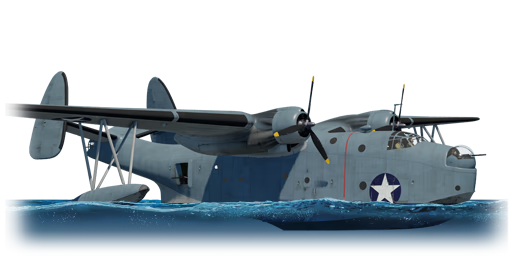
PBM-3 "Mariner"


Martin developed the PBM-1 Mariner to replace the aging Catalinas as a maritime patrol aircraft. However, the aircraft ended up being too expensive, and the difference in flight performance was not significant enough. To address this, Martin installed more powerful engines, replaced the retractable floats with larger fixed ones, slightly redesigned the bomb bays, and lengthened the fuselage to provide more stability in flight and at sea. Nevertheless, the aircraft remained more expensive than the Catalina. In 1943, only 32 units of the new variant, the PBM-3 Mariner, were ordered. The flying boats remained in service with the U.S. until the early 1950s, when they were replaced by the P5M Marlin.
The PBM-3 "Mariner" was introduced as one of the rewards for the 2019 "Sea Voyage" event. It is a flying boat with excellent bomb load capacity and good survivability. The large number of sea mines it carries is an added bonus. However, the aircraft is large and slow, and its defensive armament is weak.

flaps
flaps
flaps
brake
control
| Belt | Belt filling | Armor penetration (mm) at a distance: | |||||
|---|---|---|---|---|---|---|---|
| 10 m | 100 m | 500 m | 1000 m | 1500 m | 2000 m | ||
| T/AP/I/AP-I | 30 | 27 | 20 | 13 | 9 | 6 | |
| AP/AP/AP/T | 30 | 27 | 20 | 13 | 9 | 6 | |
| AP-I/AP-I/AP-I/T | 28 | 26 | 18 | 11 | 7 | 4 | |
| Name | Weight | Slot | ||||
|---|---|---|---|---|---|---|
| 721.2 kg |  | | ||||
| 884 kg |  | | ||||
| 6 × | 299.4 kg |  | | |||
| 4 × | 970.4 kg |  | | |||
| 4 × | 2,003 kg |  | | |||
| 4 × | 2,884.8 kg |  | | |||
| 4 × | 1,977.6 kg |  | | |||


 2 x (55 / 190 / 205) %
2 x 124 %
2 x (55 / 190 / 205) %
2 x 124 %
Flight performance | |
|---|---|
Weaponry | ||
|---|---|---|