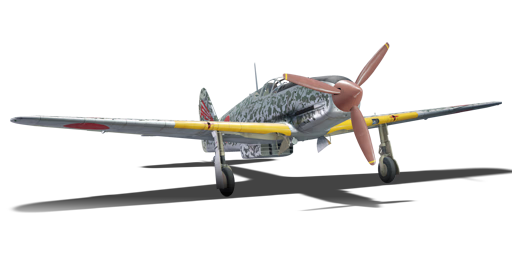
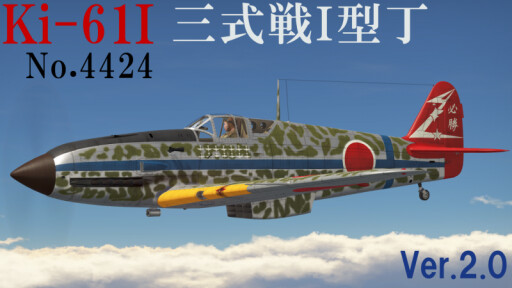
Ki-61-I Tei



The Ki-61-I tei (丁), designated Type 3 Fighter, Model 1D (三式戦闘機一型丁), was the fourth variant of the Kawasaki Ki-61 series, built from January 1944 to January 1945. After imported Mauser MG 151/20 cannons and ammunition stocks used by the hei model were exhausted, the Army sought to maintain 20 mm armament through the domestically produced Ho-5 cannon – an enlarged development of the Ho-103 12.7 mm. Although less powerful than the German weapon, its compact design allowed installation in the nose, improving accuracy and concentration of fire. The major armament revision required extensive airframe changes, including a lengthened nose, wings shifted slightly forward, rear ballast, and a reduced main fuel tank. These modifications, meant to mitigate the Ki-61-I hei's performance loss, ultimately reduced overall flight performance even further.
Due to the scale of these structural changes, the aircraft was initially designated Ki-61-I Kai, though this was later standardised as Ki-61-I tei. Although it was intended to be succeeded by the Ki-61-II, severe delays and persistent reliability issues with the new Ha-140 engine proved even more problematic than the Ha-40 issues. As a result, the tei remained in production longer than expected and became the most produced Ki-61 variant.
The Ki-61-I tei was introduced in Update 1.55 “Royal Armour”. It combines concentrated nose-mounted 20 mm firepower with the familiar Ki-61 handling. While slightly heavier and marginally less agile than earlier models, it benefits from improved gun accuracy due to its centreline armament, making deflection shots more consistent and reducing convergence concerns. The aircraft performs best as an energy fighter, using its solid dive performance, stable gun platform, and respectable mid-altitude speed to deliver decisive bursts before disengaging.

flaps
flaps
flaps
brake
| Belt | Belt filling | Armor penetration (mm) at a distance: | |||||
|---|---|---|---|---|---|---|---|
| 10 m | 100 m | 500 m | 1000 m | 1500 m | 2000 m | ||
| HEF-I/P/AP-T | 27 | 25 | 17 | 10 | 6 | 4 | |
| HEF-I/HEF-I/AP-T | 27 | 25 | 17 | 10 | 6 | 4 | |
| AP-T/AP-T/HEF-I | 27 | 25 | 17 | 10 | 6 | 4 | |
| AP-T | 27 | 25 | 17 | 10 | 6 | 4 | |
| HEF-I/HEF-I/HEF-I/P | 16 | 13 | 8 | 6 | 0 | 0 | |
| Belt | Belt filling | Armor penetration (mm) at a distance: | |||||
|---|---|---|---|---|---|---|---|
| 10 m | 100 m | 500 m | 1000 m | 1500 m | 2000 m | ||
| AP-T/AP/HEF-I | 21 | 19 | 13 | 7 | 4 | 3 | |
| AP-T/HEF-I/AP/HEF-I | 21 | 19 | 13 | 7 | 4 | 3 | |
| AP-T/HEF-I/HEF-I/HEF-I | 21 | 19 | 13 | 7 | 4 | 3 | |
| AP-T/AP/AP-T | 21 | 19 | 13 | 7 | 4 | 3 | |
| AP/HEF-I/HEF-I/HEF-I | 21 | 19 | 13 | 7 | 4 | 3 | |


Flight performance | |
|---|---|
Survivability |
|---|
Weaponry | ||
|---|---|---|