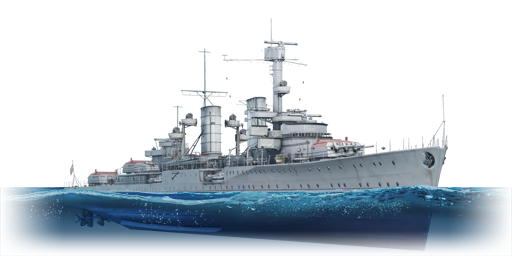
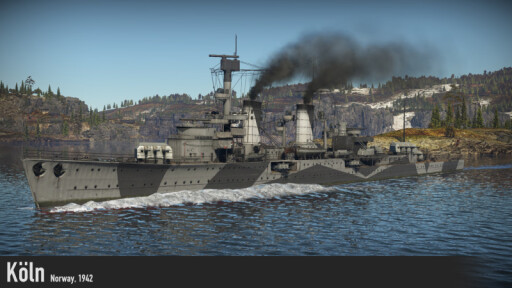
The Köln was a light cruiser that served in the Kriegsmarine during the 1930s and throughout World War II. She was the third ship of the Königsberg class, also known as the K-class, as all three ships were named after cities beginning with K. It was developed in response to the Treaty of Versailles, which limited the Reichsmarine to 6,000 tons. To meet these limits while remaining modern, weight reduction was emphasised: the hull was primarily welded instead of riveted. For maximum range, a hybrid propulsion system combining steam turbines and diesel engines was employed, the first of its kind in the world. Equally innovative was the armament of three triple turrets. A distinctive feature was the unusual arrangement of the two aft turrets (Bruno and Caesar), offset to port and starboard from the centreline to maximise firepower during pursuit or rearguard actions while fitting the narrow hull.
The Köln was laid down on August 7, 1927, launched on May 23, 1928, and commissioned on January 15, 1930. From December 1932 to December 1933, she undertook a world cruise for officer training. The Köln and her sister ships primarily served propaganda purposes, participating in several Kriegsmarine operations, including the Spanish Civil War and the annexation of Memel (now Lithuania). During World War II, she attempted to prevent the escape of the Polish fleet without success and provided naval support during the Norwegian Campaign. She also tested the Fi 282 helicopter, which could take off from a platform atop turret Bruno. She supported the capture of the Moonsund Islands and operations in the Gulf of Riga, chased Arctic convoys, patrolled the North Sea, and underwent repairs and modernisation. In December 1944, she was severely damaged in a bombing raid and taken to Wilhelmshaven. On March 31, 1945, she was further damaged and ran aground, but her two aft triple turrets still protruded, allowing her to defend Wilhelmshaven until her ammunition ran out. She was finally scuttled on May 2, 1945, and partially dismantled and scrapped in 1946 before being fully raised and scrapped in 1956.
The Köln was introduced in Update 1.85 “Supersonic” in her 1940 configuration. She offers decent mobility and acceptable main armament performance, making her effective against destroyers and lightly armoured cruisers. However, her overall survivability is limited due to weak armour protection and vulnerable internal modules. Additionally, her anti-aircraft armament is relatively weak, leaving her exposed to aerial attacks.