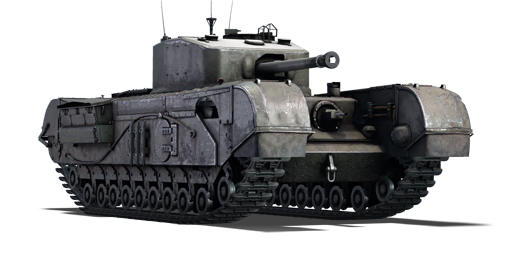
Churchill VII



The Churchill VII Infantry Tank Mk IV (A22F) was a heavy tank used by the British Army. It was originally developed to replace the Matilda and Valentine tanks. During its development, designers followed the concept of trench warfare; however, after France's defeat in 1940, this approach was deemed outdated. The design was revised, and the tank entered production in June 1941. At the same time, continuous improvements were made to its protection and firepower. The result was the Churchill VII, featuring 152 mm (6 in) of frontal armor, 95 mm (3.7 in) of side armor, a reinforced suspension, and a 75 mm (3.9 in) OQF Mk. V gun.
These tanks participated in the Allied landings in Normandy and saw action in Europe until the end of World War II. The exact number produced is difficult to determine because contracts with manufacturers were frequently revised, leading to changes in production numbers. However, historians generally estimate that around 1,400 A22F tanks (Churchill VII and VIII models) were built.
The Churchill VII was introduced in Update 1.55 "Royal Armor". The tank has strong armor and good survivability but mediocre mobility and a relatively weak gun.

| Ammunition | Type | Armor penetration (mm) at a distance: | |||||
|---|---|---|---|---|---|---|---|
| 10 m | 100 m | 500 m | 1000 m | 1500 m | 2000 m | ||
| AP | 91 | 88 | 78 | 67 | 57 | 49 | |
| HE | 10 | 10 | 10 | 10 | 10 | 10 | |
| Smoke | 3 | 3 | 3 | 3 | 3 | 3 | |
| APCBC | 104 | 102 | 93 | 84 | 75 | 68 | |
| Belt | Belt filling | Armor penetration (mm) at a distance: | |||||
|---|---|---|---|---|---|---|---|
| 10 m | 100 m | 500 m | 1000 m | 1500 m | 2000 m | ||
| AP-I/AP-I/AP-T | 9 | 8 | 6 | 3 | 0 | 0 | |


Mobility | |
|---|---|
Protection |
|---|
Firepower | |
|---|---|