
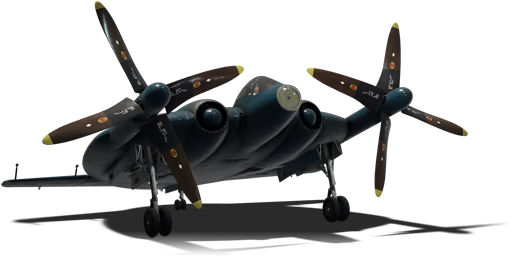


The Vought XF5U, better known by its nicknames Flying Flapjack or Flying Pancake, was an experimental fighter aircraft developed for the US Navy in 1941. The aircraft's unusual disc-shaped profile (hence the nickname) was the result of research on low-aspect-ratio wings by aeronautical engineer Charles H. Zimmermann to maximise the angle of attack and speed while also minimising stall speed for shorter take-off and landing. To counteract the induced drag inherent in the low-aspect-ratio wing design, the XF5U featured a pair of propellers at the furthest edges of the wings, powered by a pair of Pratt & Whitney Twin Wasp engines located inside their own compartments with separate air intakes, with both engines simultaneously driving both propellers via separate shafts.
Due to its potential use on board aircraft carriers and the successful flight of the earlier Vought V-173 test aircraft in 1942, the US Navy ordered two prototypes to be built, of which only one was completed. However, due to severe vibration issues, the XF5U was unable to fly when tests began in 1945. This, along with the emergence of upcoming jet aircraft designs, led the US Navy to cancel the XF5U project on 17 March 1947. The sole prototype had to be destroyed using a wrecking ball due to its exceptionally strong durability.
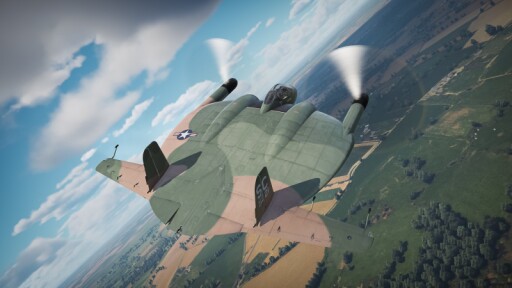
The XF5U-1 was introduced during Update 2.49 "Tusk Force" as the reward for the 2025 "Dreams Come True" event. The "Flying Pancake" is unusual in many aspects: due to its profile, it has a very low stall speed to the point that it can climb almost vertically, and it can take an absurd amount of damage due to its “wings” being the fuselage itself. The flight performance is rather average, though it is capable of reaching significant speed in a dive. However, owing to its unorthodox design, the XF5U-1 also suffers from many drawbacks: its energy retention is atrocious (especially in vertical manoeuvres) and it can be sent into an unrecoverable spin if one of its propellers is disabled.

flaps
flaps
flaps
brake
| Belt | Belt filling | Armor penetration (mm) at a distance: | |||||
|---|---|---|---|---|---|---|---|
| 10 m | 100 m | 500 m | 1000 m | 1500 m | 2000 m | ||
| API-T/AP/AP/I | 30 | 27 | 20 | 13 | 9 | 6 | |
| AP-I/AP-I/API-T/I/I | 28 | 26 | 18 | 11 | 7 | 4 | |
| API-T/I/AP/AP/AP-I/AP-I | 30 | 27 | 20 | 13 | 9 | 6 | |
| API-T | 28 | 26 | 18 | 11 | 7 | 4 | |
| AP-I/I/AP-I/I | 28 | 26 | 18 | 11 | 7 | 4 | |
| Name | Weight | Slot | ||||||
|---|---|---|---|---|---|---|---|---|
| 242.6 kg |  | | ||||||
| 500.8 kg |  | | ||||||


 2 x (95 / 230 / 475) %
2 x 172 %
2 x (95 / 230 / 475) %
2 x 172 %
Flight performance | |
|---|---|
Survivability |
|---|
Weaponry | |
|---|---|