
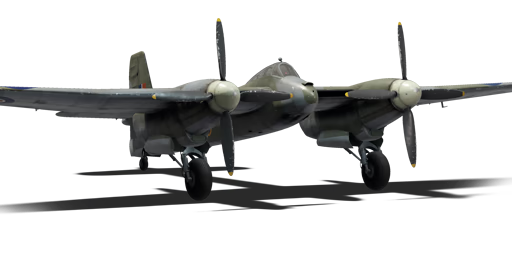
Welkin F.Mk.I



Upon the arrival of German high-altitude Ju 86P bombers, the Royal Air Force (RAF) began developing a high-altitude interceptor. The Air Force was primarily concerned about the potential for renewed bombing raids on Britain from high altitudes. In 1940, Westland proposed adapting the Whirlwind fighter for this new mission. To accomplish this, they significantly increased the aircraft's wingspan and replaced its original engines with Rolls-Royce Merlins. A pressurized cockpit was also introduced.
In January 1941, the Ministry of Aircraft Production approved the construction of two Westland P.14 prototypes, pitting them against a single Vickers Type 432 prototype. The first prototype took to the skies on November 1, 1942, and the second in March 1943. The RAF deemed the fighter superior to other alternatives, designated it the Welkin, and ordered 100 F.Mk.I. aircraft. Despite entering series production, the aircraft was highly problematic. Due to the large wing thickness required for such a wingspan, the aircraft was prone to stalling or shock stall. Furthermore, the Welkin was heavy, making it useful only for intercepting high-altitude bombers. By the time the Welkin entered service in May 1944, high-altitude variants of the Spitfire were already performing this task successfully. Consequently, the Welkin was used for training in intercept tactics and never saw combat. By November, the fighter had been withdrawn from frontline units, and production halted at 77 aircraft, including prototypes.
The Welkin F.Mk.I was introduced Update 2.57 "Heavy Cavalry". It is a fighter with powerful offensive armament, good vertical maneuverability, and generally good performance at high altitudes. However, it has a low top speed and poor roll rate.

flaps
flaps
flaps
brake
| Belt | Belt filling | Armor penetration (mm) at a distance: | |||||
|---|---|---|---|---|---|---|---|
| 10 m | 100 m | 500 m | 1000 m | 1500 m | 2000 m | ||
| HEI/SAP-I/T | 22 | 20 | 14 | 9 | 6 | 4 | |
| AP-T/HEI/SAP-I | 37 | 35 | 25 | 16 | 10 | 7 | |
| AP-T/HEI/SAP-I/HEI/SAP-I | 37 | 35 | 25 | 16 | 10 | 7 | |
| AP-T/HEI/AP-T | 37 | 35 | 25 | 16 | 10 | 7 | |
| AP-T/SAP-I/HEI/AP-T | 37 | 35 | 25 | 16 | 10 | 7 | |
| HEI/HEI/SAP-I | 22 | 20 | 14 | 9 | 6 | 4 | |


Flight performance | ||
|---|---|---|
Survivability |
|---|
Weaponry |
|---|