
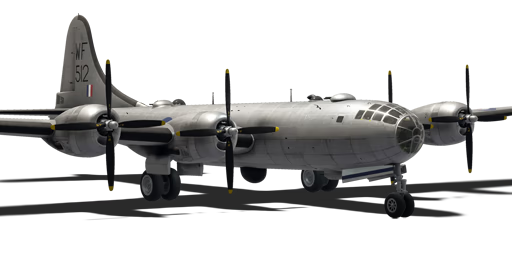
Washington B.Mk.I



During the early 1950s, the Royal Air Force was in need of a modern bomber; the then-latest Avro Lincoln was deemed obsolete, and the development of jet bombers was still underway. Therefore, a decision was made to loan 87 Boeing B-29 Superfortresses from the US Air Force to fill the gap, which were designated the Washington B.1. As the English Electric Canberra entered service in 1953, the Washington was gradually phased out, with some being used for patrol and radar picket duties, while a handful were given to Australia for research purposes. The last remaining aircraft were retired in 1958 and eventually returned to the US.
Introduced in Update 2.57 "Heavy Cavalry", the Washington B.1 is identical to its counterpart in the US tech tree. The Washington is a pure heavy bomber with the sole purpose of delivering a massive payload over long ranges. As it commonly faces early jets, high altitude is the best place to stay out of sight of interceptors. Should anyone manage to catch up with it, the Washington can utilise its numerous .50 cal machine guns to ward them off.

flaps
flaps
flaps
brake
| Belt | Belt filling | Armor penetration (mm) at a distance: | |||||
|---|---|---|---|---|---|---|---|
| 10 m | 100 m | 500 m | 1000 m | 1500 m | 2000 m | ||
| API-T/AP/AP/I | 30 | 27 | 20 | 13 | 9 | 6 | |
| AP/AP/AP/API-T | 30 | 27 | 20 | 13 | 9 | 6 | |
| AP-I/I/AP-I/API-T | 28 | 26 | 18 | 11 | 7 | 4 | |
| Belt | Belt filling | Armor penetration (mm) at a distance: | |||||
|---|---|---|---|---|---|---|---|
| 10 m | 100 m | 500 m | 1000 m | 1500 m | 2000 m | ||
| API-T/AP/AP/I | 30 | 27 | 20 | 13 | 9 | 6 | |
| AP/AP/AP/API-T | 30 | 27 | 20 | 13 | 9 | 6 | |
| AP-I/I/AP-I/API-T | 28 | 26 | 18 | 11 | 7 | 4 | |


Flight performance | |
|---|---|
Survivability |
|---|
Weaponry | ||
|---|---|---|