
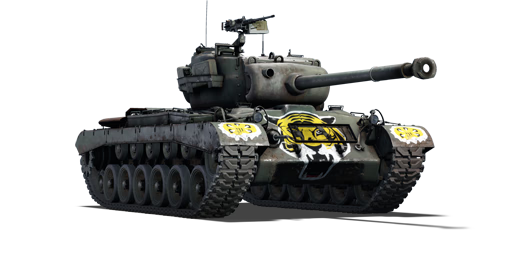
M46 "Tiger"



The M46 Patton was an American medium tank developed from the M26 Pershing. Originally classified as a heavy tank, the M26 was redesignated a medium tank after World War II, though its mobility was considered insufficient for the role. In January 1948, work began to replace its powerplant with a Continental AV1790-3 engine and an Allison CD-850-1 transmission. Initially designated the M26E2, the project received additional modifications, prompting the Ordnance Department to give it a new designation: the M46. The upgraded vehicle received a new powerplant and main gun. After completing production of the first batch in November 1948, the tank was named the M46 Patton in honor of the late General George S. Patton. By December, the U.S. Army had ordered several hundred vehicles. By July 1950, the Detroit Arsenal was producing more than a dozen tanks per day, including Pershings and M46s. In total, 1,160 M46 tanks of all variants were produced, many of which saw combat during the Korean War.
The first batch of tanks arrived in Korea on August 8, 1950, with the 6th Tank Battalion. There, they demonstrated superiority over North Korean and Chinese T-34-85 tanks. By the end of 1950, around 200 M46 Pattons had been deployed to Korea. Later, all M26 Pershings and Sherman tanks were replaced by M46 Pattons. The 73rd Tank Battalion, formed in 1949 and stationed in Korea throughout the war, was also equipped with M46 Pattons. Between February and March of 1951, the battalion's tank crews painted their tanks with colorful tiger-themed designs as part of a psychological warfare campaign against enemy forces. This was based on Korean and Chinese superstitions regarding cats, particularly tigers, which were regarded as symbols of power and authority in the mountains and forests. It was believed that such markings could intimidate some of the enemy soldiers, who were highly superstitious.
The M46 "Tiger" was introduced in Update 1.45 "Steel Generals". Compared to the standard version, it features a unique tiger-themed camouflage pattern. In battle, the tank offers good mobility and maneuverability, a powerful gun with HEAT and APCBC ammunition, and respectable armor protection for a medium tank. The M46 can be used effectively to capture key positions or perform flanking maneuvers. Its excellent gun depression angles and wide selection of ammunition allow it to perform well across different terrain types and combat distances.

| Ammunition | Type | Armor penetration (mm) at a distance: | |||||
|---|---|---|---|---|---|---|---|
| 10 m | 100 m | 500 m | 1000 m | 1500 m | 2000 m | ||
| APBC | 175 | 173 | 161 | 147 | 135 | 123 | |
| HE | 20 | 20 | 18 | 17 | 16 | 16 | |
| APCBC | 185 | 183 | 173 | 161 | 150 | 140 | |
| APCR | 287 | 281 | 259 | 234 | 211 | 191 | |
| APCR | 291 | 286 | 264 | 240 | 217 | 197 | |
| HEATFS | 305 | 305 | 305 | 305 | 305 | 305 | |
| Smoke | 5 | 5 | 5 | 5 | 5 | 5 | |
| Belt | Belt filling | Armor penetration (mm) at a distance: | |||||
|---|---|---|---|---|---|---|---|
| 10 m | 100 m | 500 m | 1000 m | 1500 m | 2000 m | ||
| API-T/I/AP/API-T | 31 | 29 | 21 | 14 | 9 | 6 | |
| Belt | Belt filling | Armor penetration (mm) at a distance: | |||||
|---|---|---|---|---|---|---|---|
| 10 m | 100 m | 500 m | 1000 m | 1500 m | 2000 m | ||
| AP/T | 13 | 12 | 7 | 3 | 2 | 0 | |

 2 x (130 / 195 / 220) %
2 x 190 %
2 x (130 / 195 / 220) %
2 x 190 %
Mobility | |
|---|---|
Protection |
|---|
Firepower | ||
|---|---|---|