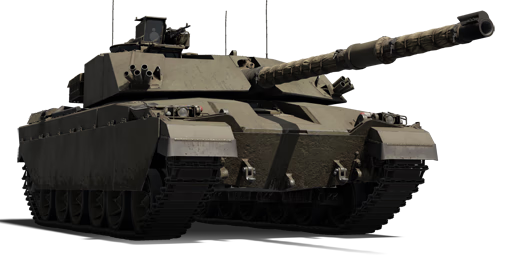
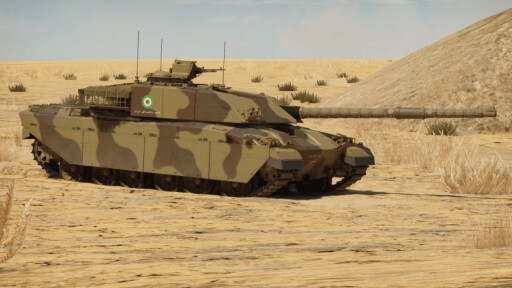
During the 1970s, Imperial Iran began procuring a large amount of modern military hardware from its Western allies to serve as a deterrent against its communist neighbours, the USSR and Afghanistan. Among these orders was an upgraded variant of the Chieftain Mk.5 MBT for Iranian service. Three variants were presented as a gradual upgrade package over time: the basic FV4030/1 with a laser rangefinder and reinforced underbelly armour; the FV4030/2 Shir 1 (Lion 1) with an upgraded engine and revamped transmission; and the FV4030/3 Shir 2 (Lion 2). The Shir 2 represented a completely new MBT design that shared only some components with the Chieftain, featuring Chobham composite armour built into the frontal hull and turret of the tank. However, the Islamic Revolution in 1979 led to the cancellation of the Iranian orders. Despite this, the Shir 2 project provided a valuable starting point for British MBT development, which later resulted in the cancellation of the MBT-80 project in favour of a new MBT based on this design, designated FV4030/4 Challenger.
The FV4030/3 was introduced as a reward for the 2025 "Enter the Serpent" event. As a precursor to the Challenger 1 MBT series, it is comparable to the Challenger Mk.2, with the main differences being the lack of a thermal device, slightly worse gunner optics, and a terrible stock shell. While the starting L15A5 APDS shell lacks any stopping power against its peers, the Shir 2's potential can be realised after unlocking the L23 APFSDS shell. Due to the Chobham armour, the Shir 2 is capable of withstanding damage from most rounds, especially chemical rounds. However, as with the rest of the Challenger 1 family, the Shir 2 suffers from underpowered engines and low top speed that often leave it lagging behind its peers.