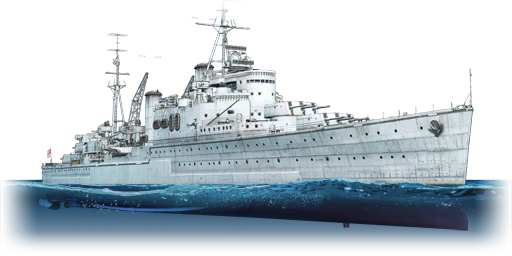
HMS Fiji (C58) was the lead ship of 11 Crown Colony-class light cruisers built for the Royal Navy in 1938. The Crown Colony-class was essentially a scaled-down, more compact version of the preceding Town-class light cruiser, to comply with the tonnage restrictions of the Second London Naval Treaty. In order to retain the full set of armaments of the Town-class, the Crown Colony class’s overall dimensions and armour were significantly reduced, resulting in an extremely cramped interior.
As for Fiji, she was laid down on 30 March 1938 at the John Brown & Co. shipyard in Clydebank, launched on 31 May 1939, and commissioned on 5 May 1940. On 31 August, Fiji sortied to take part in Operation Menace to attack the port of Dakar, but she was forced to return home after being torpedoed by the German submarine U-32 the next day. After repairs, she was sent to patrol the Denmark Strait in March 1941 before sailing to the Mediterranean to take part in the Battle of Crete in May. On 22 May, Fiji and HMS Gloucester were ordered to provide anti-air cover for the rescue of survivors from the recently sunk destroyer HMS Greyhound, despite the low reserve of AA ammunition on board both ships. The British fleet was later targeted by Luftwaffe aircraft, forcing both cruisers to expend all of their AA ammunition. As Fiji and Gloucester were rendered defenceless by 19:00, a flight of Bf 109 fighters bombed both ships unopposed, resulting in the sinking of both vessels. Following the sinking, the Royal Navy instructed all cruisers not to allow their AA ammunition reserves to fall below 40% before sortieing.
HMS Fiji was introduced in Update 2.53 "Line of Contact". As a compact version of the Town-class cruisers, Fiji features very strong firepower for her rank as well as decent mobility. However, due to the lack of AP shells, she is forced to get close to heavier targets to deal damage. Due to the cramped placement of crew compartments and modules, Fiji is at risk of losing a large number of her crew from just a few hits.