
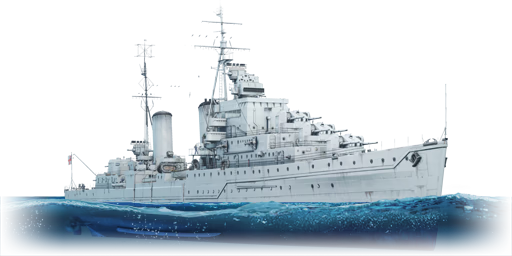
HMS Dido



HMS Dido (37) is the lead ship of the Dido-class light cruisers. She was named after Dido, the queen and founder of Carthage, and the love of Aeneas. Ordered by the Royal Navy in 1936 in accordance with the London Naval Treaty of the same year, she was laid down at the Cammell Laird shipyard in Birkenhead on October 20, 1937. Launched on July 18, 1939, she entered service on September 30, 1940, becoming the sixth ship to bear this name in the British Navy since 1784. Dido was also the first ship equipped with the latest Type 281 early warning radar.
After entering service, she was tasked with escorting Atlantic convoys. In April 1941, she was transferred to the Mediterranean Fleet, where she continued escorting convoys, this time to Malta. In May, she participated in the evacuation of the Greek gold reserve to Egypt. She also participated in the landing of troops in Assab, Eritrea. She went to New York for repairs until November, after which she continued to escort convoys in the Mediterranean Sea. The ship participated in the bombing of Rhodes and later in the Second Battle of Sirte. Subsequently, she provided support to British troops in North Africa and performed air defense functions for the ports of Bona and Algiers. In July 1943, she took part in Operation Husky, landing troops in northern Sicily. She performed air defense functions during the capture of Palermo and Bizerte. She escorted convoys to Taranto, where the Italian fleet surrendered. From there, she proceeded to Sorrento to support the Allied offensive. After undergoing repairs in Alexandria, she participated in a diversionary maneuver at Civitavecchia in support of the Anzio landing. In August 1944, she supported the landing in southern France. In September, she returned to Great Britain. Afterwards, she was engaged in escorting Arctic convoys to the USSR. The Kriegsmarine's act of surrender was signed aboard Dido. After the war, she was placed in reserve. In 1953, she served as the flagship of the reserve fleet at the coronation of Elizabeth II naval review. In 1957, the ship was sold for scrap.
HMS Dido was introduced in Update 1.85 “Supersonic” in her 1941 modification. The ship is fairly average in terms of performance, but she has decent hull armor and a large number of versatile main guns. Her disadvantages include low mobility and weak main gun damage.

| Ammunition | Type | Armor penetration (mm) at a distance: | |||||
|---|---|---|---|---|---|---|---|
| 1000 m | 2500 m | 5000 m | 7500 m | 10000 m | 15000 m | ||
| HE | 35 | 35 | 35 | 35 | 35 | 35 | |
| SAPBC | 169 | 143 | 106 | 76 | 56 | 49 | |
| HE-VT | 35 | 35 | 35 | 35 | 35 | 35 | |
| Belt | Belt filling | Armor penetration (mm) at a distance: | |||||
|---|---|---|---|---|---|---|---|
| 10 m | 100 m | 500 m | 1000 m | 1500 m | 2000 m | ||
| HEF/AP-T/HEF/AP-T | 60 | 57 | 50 | 43 | 38 | 34 | |
| HEF/HEF/HEF/AP-T | 60 | 57 | 50 | 43 | 38 | 34 | |
| AP-T/AP-T/AP-T/HEF | 60 | 57 | 50 | 43 | 38 | 34 | |
| Belt | Belt filling | Armor penetration (mm) at a distance: | |||||
|---|---|---|---|---|---|---|---|
| 10 m | 100 m | 500 m | 1000 m | 1500 m | 2000 m | ||
| HEF-T/AP-T | 34 | 32 | 26 | 21 | 18 | 16 | |


Seakeeping |
|---|
Unsinkability | |
|---|---|
Firepower | ||
|---|---|---|