
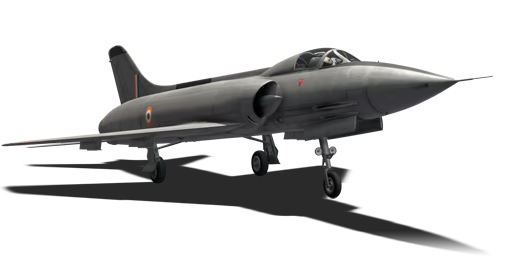
▄HF-24


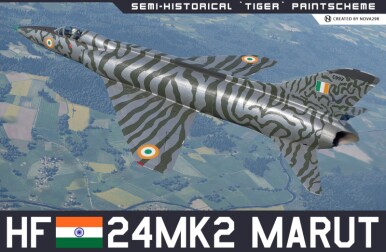
In the 1950s, Hindustan Aeronautics Limited (HAL) decided to enter the supersonic aviation market. At the time, HAL was producing simple training aircraft. Around this time, the Indian Air Force was looking to acquire a new fighter-bomber. The Indian government allocated funds for the aircraft's construction. Since HAL lacked experience with such technology, the company brought in Kurt Tank, known for his Fw 190 and a number of jet fighter projects. Despite the government's constantly changing requirements, a full-scale wooden model took to the skies on April 3, 1959, with the help of a Douglas Dakota transport aircraft. The new aircraft was designated the HF-24 Marut, named after the Maruts, gods of thunderstorms.
The prototype with a Bristol Siddeley Orpheus 703 engine made its first flight on June 24, 1961. However, the Orpheus proved to be a weak engine incapable of supersonic flight. The subsequent deterioration of India's relations with the West made obtaining a new, more powerful engine impossible, so all 147 aircraft were built with the Orpheus 703. Due to Kurt Tank's unwillingness to negotiate with the Indian government regarding design changes, the Air Force's lackadaisical attitude toward the project, and the inability to develop a powerful engine independently, the HF-24s were withdrawn from service by 1982. They only saw action during the third Indo-Pakistani War of 1971.
The Indian HF-24 was introduced as a reward for the 2025 "Spirit of the Tempest" event in the British air research tree. It is an aircraft with good main armament and an impressive array of weapons for attacking ground targets. However, it has three major drawbacks: it is subsonic, has poor maneuverability and lacks air-to-air missiles.

flaps
flaps
flaps
brake
| Belt | Belt filling | Armor penetration (mm) at a distance: | |||||
|---|---|---|---|---|---|---|---|
| 10 m | 100 m | 500 m | 1000 m | 1500 m | 2000 m | ||
| AP/HEI-T | 37 | 34 | 22 | 13 | 8 | 5 | |
| AP/HEI-T/AP | 37 | 34 | 22 | 13 | 8 | 5 | |
| HEF-I/HEI-T | 4 | 4 | 4 | 4 | 4 | 4 | |
| AP/HEF-I | 37 | 34 | 22 | 13 | 8 | 5 | |
| Name | Weight | Slot | ||||
|---|---|---|---|---|---|---|
| 4 × | 114 kg |  | | | | |
| 18 × | 183.9 kg |  | | | | |
| 235 kg |  | | | | ||
| 254.9 kg |  | | | | ||
| 486 kg |  | | | | ||
| 486 kg |  | | | | ||
| Drop tank (100 gal.) | 68 kg |  | | | | |
| 50 × | 252.5 kg |  | ||||



Flight performance | |
|---|---|
Survivability |
|---|
Weaponry | ||
|---|---|---|