
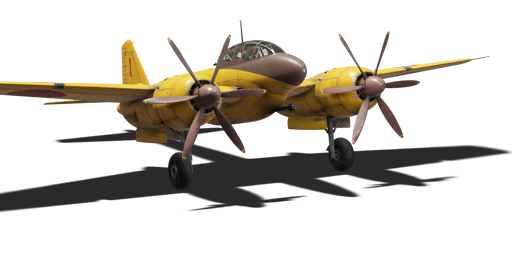
Ki-93-I Ko



The Rikugun Ki-93-I Ko was a Japanese twin-engine heavy fighter and ground-attack aircraft developed by the Army Aerotechnical Research Institute as a heavily armed aircraft capable of engaging enemy bombers and ground targets. Development began in 1941, with the design later transferred to the First Army Air Arsenal at Tachikawa, where it was refined around two Mitsubishi Ha-214 radial engines and a heavily armoured crew compartment.
Two variants were planned: the Ki-93-I Ko for bomber interception, armed with a 57 mm Ho-402 cannon and two 20 mm Ho-5 cannons, and the Ki-93-I Otsu for anti-shipping and ground attack, which was to carry a 75 mm Type 88 cannon and two 250 kg bombs. The first prototype was completed and made its maiden flight on 8 April 1945, but was damaged in a landing accident and subsequently destroyed in an American air raid before repairs could be completed. A second prototype of the Otsu variant was completed but never flown.
The Ki-93-I Ko was introduced in Update 2.59 "Sky Odyssey". Its main strength is its exceptional forward firepower, with the 57 mm Ho-402 capable of heavily damaging or destroying bombers and other large aircraft with a well-placed HE shell, while its APHE shell can penetrate roughly 70 mm of armour against ground vehicles. The two 20 mm Ho-5 cannons provide additional firepower against softer targets or increase its burst mass against aircraft. The aircraft is well armoured, with 12 mm steel plates protecting the crew and a relatively small fuel tank, while its two high-output Ha-214 engines provide relatively good flight performance, particularly at high altitude.

flaps
flaps
flaps
brake
| Belt | Belt filling | Armor penetration (mm) at a distance: | |||||
|---|---|---|---|---|---|---|---|
| 10 m | 100 m | 500 m | 1000 m | 1500 m | 2000 m | ||
| APHE/HEF | 78 | 76 | 68 | 59 | 51 | 44 | |
| HEF | 7 | 6 | 6 | 6 | 6 | 6 | |
| APHE | 78 | 76 | 68 | 59 | 51 | 44 | |
| Belt | Belt filling | Armor penetration (mm) at a distance: | |||||
|---|---|---|---|---|---|---|---|
| 10 m | 100 m | 500 m | 1000 m | 1500 m | 2000 m | ||
| HEF-I/P/AP-T | 27 | 25 | 17 | 10 | 6 | 4 | |
| HEF-I/HEF-I/AP-T | 27 | 25 | 17 | 10 | 6 | 4 | |
| AP-T/AP-T/HEF-I | 27 | 25 | 17 | 10 | 6 | 4 | |
| AP-T | 27 | 25 | 17 | 10 | 6 | 4 | |
| HEF-I/HEF-I/HEF-I/P | 16 | 13 | 8 | 6 | 0 | 0 | |
| Belt | Belt filling | Armor penetration (mm) at a distance: | |||||
|---|---|---|---|---|---|---|---|
| 10 m | 100 m | 500 m | 1000 m | 1500 m | 2000 m | ||
| AP-T/AP/HEF-I | 21 | 19 | 13 | 7 | 4 | 3 | |
| AP-T/AP/AP-T | 21 | 19 | 13 | 7 | 4 | 3 | |
| AP-T/HEF-I/HEF-I/HEF-I | 21 | 19 | 13 | 7 | 4 | 3 | |


 Ki-93-I Ko
Flight performance | |
|---|---|
Survivability |
|---|
Weaponry | |
|---|---|