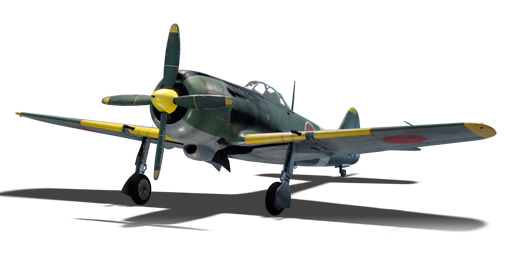



In early 1942, the Imperial Japanese Army Air Force requested a replacement for the recently introduced Ki-43 fighter. The new aircraft had to match the Ki-43’s maneuverability, as well as the performance of modern Western fighters. It also had to feature powerful armament. Nakajima, the company that developed the Ki-43, took on the task. They set out to address the Ki-43's most significant shortcomings: insufficient armament, weak armor, and a climb rate. The new aircraft, designated the Ki-84, made its maiden flight in April 1943. It provided the fighter pilot with armor consisting of a backplate and bulletproof glass, as well as more powerful armament in the form of heavy machine guns and two 20 mm cannons. The aircraft met the previously established requirements, and the military wanted it so badly that prototypes were assembled in large quantities and were often identical. However, mass production did not begin until April 1944. The first production model was the Ki-84 Ko. This was followed by the low-production Ki-84 Otsu variant, with the most notable difference being in its armament of four 20 mm Ho-5 cannons. And not long after there was a Ki-84 Hei variant with two 20 mm Ho-5 cannons and two 30 mm Ho 155. By the end of the war, 3,514 aircraft of various models had been produced.
The Ki-84 Hei was introduced in Update 1.37. Despite the arrival of new, more powerful opponents, the Ki-84 Hei retains the strengths of its predecessors, including a good climb rate smooth handling, and maneuverability. However, it loses control quickly at high speeds, its armament is difficult to use, and it is less maneuverable than other Japanese aircraft. Moreover, it doesn't have the same edge over the enemies as earlier variants used to.

flaps
flaps
flaps
brake
| Belt | Belt filling | Armor penetration (mm) at a distance: | |||||
|---|---|---|---|---|---|---|---|
| 10 m | 100 m | 500 m | 1000 m | 1500 m | 2000 m | ||
| HEF/AP-T/HEF-I | 28 | 26 | 18 | 11 | 7 | 4 | |
| HEF-I/AP-T/AP-T/HEF/HEF | 28 | 26 | 18 | 11 | 7 | 4 | |
| HEF-I/AP-T/AP-T/AP-T/AP-T | 28 | 26 | 18 | 11 | 7 | 4 | |
| AP-T | 28 | 26 | 18 | 11 | 7 | 4 | |
| HEF | 3 | 3 | 3 | 3 | 3 | 3 | |
| Belt | Belt filling | Armor penetration (mm) at a distance: | |||||
|---|---|---|---|---|---|---|---|
| 10 m | 100 m | 500 m | 1000 m | 1500 m | 2000 m | ||
| HEF-I/P/AP-T | 27 | 25 | 17 | 10 | 6 | 4 | |
| HEF-I/HEF-I/AP-T | 27 | 25 | 17 | 10 | 6 | 4 | |
| AP-T/AP-T/HEF-I | 27 | 25 | 17 | 10 | 6 | 4 | |
| AP-T | 27 | 25 | 17 | 10 | 6 | 4 | |
| HEF-I/HEF-I/HEF-I/P | 16 | 13 | 8 | 6 | 0 | 0 | |


Flight performance | |
|---|---|
Survivability |
|---|
Weaponry | |
|---|---|