
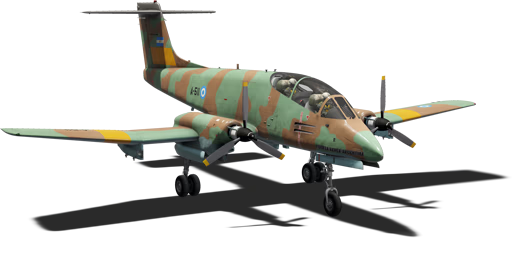
IA.58A Pucara



In August 1966, the Argentine State Aviation Factory (DINFIA) started designing a new counterinsurgency aircraft for the Argentine Air Force. For this project, the factory selected a low-wing design featuring two turboprop engines and a T-tail. On August 20, 1969, the first prototype, still known at the time as the IA.58 Delfín, took to the skies for the first time. The aircraft was soon renamed the IA.58 Pucará. The second prototype, equipped with Turbomeca Astazou engines, flew for the first time on September 6, 1970. The first production aircraft was ready in 1974, and deliveries to the Air Force began the following year.
By the start of the Falklands War in 1982, the Argentine Air Force had 60 IA.58s in service. Their low airfield requirements proved useful there, making them the only combat aircraft capable of operating directly from the Falkland Islands. Just one month after their arrival in May, three aircraft were lost following a British Harrier bombing raid; another six were lost during a raid on Pebble Island. By the end of the war, 19 aircraft had been lost, and another five were captured and taken to the United Kingdom. Meanwhile, the "Pucará" was responsible for Argentina's only aerial victory of the conflict when two aircraft shot down a Westland Scout helicopter during the Battle of Goose Green. Following modifications, the IA 58 remains in service with the Argentine Air Force. Several more aircraft were also used by the air forces of Sri Lanka, Uruguay, and Colombia.
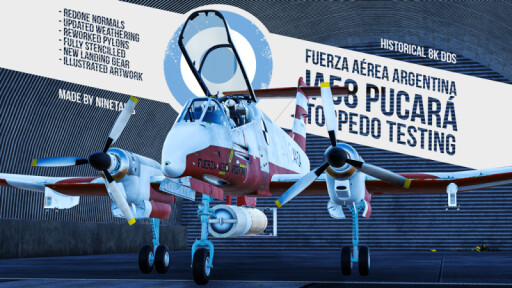
The Argentine IA.58A Pucara was introduced in Update 2.57 "Heavy Cavalry", in the German aviation research tree. The aircraft stands out for its powerful armament, decent WEP performance, and JATO boosters. However, it loses a significant amount of maneuverability without flaps, and the duration of the water-injected WEP is limited.

flaps
flaps
flaps
brake
| Belt | Belt filling | Armor penetration (mm) at a distance: | |||||
|---|---|---|---|---|---|---|---|
| 10 m | 100 m | 500 m | 1000 m | 1500 m | 2000 m | ||
| HEF-I/HEF-T/AP-I | 38 | 35 | 24 | 15 | 9 | 6 | |
| AP-T/HEF-I | 38 | 35 | 24 | 15 | 9 | 6 | |
| AP-T/AP-I/AP-T/HEF-I | 38 | 35 | 24 | 15 | 9 | 6 | |
| AP-T/HEF-T | 38 | 35 | 24 | 15 | 9 | 6 | |
| AP-I/HEF-I | 38 | 35 | 24 | 15 | 9 | 6 | |
| Belt | Belt filling | Armor penetration (mm) at a distance: | |||||
|---|---|---|---|---|---|---|---|
| 10 m | 100 m | 500 m | 1000 m | 1500 m | 2000 m | ||
| T/Ball/Ball/Ball/AP/I | 13 | 12 | 7 | 3 | 2 | 0 | |
| T/AP/I | 13 | 12 | 7 | 3 | 2 | 0 | |
| AP/T/T/T/T | 13 | 12 | 7 | 3 | 2 | 0 | |
| AP/AP/AP/I/I | 13 | 12 | 7 | 3 | 2 | 0 | |
| Name | Weight | Slot | ||||||
|---|---|---|---|---|---|---|---|---|
| 19 × | 229.6 kg |  | | | ||||
| 38 × | 459.3 kg |  | | |||||
| 6 × | 223 kg |  | | | ||||
| 6 × | 52 kg |  | | | ||||
| 18 × | 156 kg |  | | | ||||
| 3 × | 353.7 kg |  | | | ||||
| 3 × | 353.7 kg |  | | | ||||
| 240.9 kg |  | | | |||||
| 2 × | 481.8 kg |  | | |||||
| 362.4 kg |  | | | |||||
| 446.8 kg |  | | | |||||
| 254 kg |  | | | |||||
| 2 × | 508 kg |  | | |||||
| 446.8 kg |  | | | |||||
| 230 kg |  | | | |||||
| 2 × | 460 kg |  | | |||||
| 57 × | 688.9 kg |  | ||||||
| 18 × | 669 kg |  | ||||||
| 6 × | 707.4 kg |  | ||||||
| 3 × | 722.7 kg |  | ||||||
| 2 × | 724.8 kg |  | ||||||
| 3 × | 762 kg |  | ||||||
| 3 × | 690 kg |  | ||||||
| 964.8 kg |  | |||||||
| 3 × Start JATO rocket booster | 133.5 kg |  | ||||||


 2 x (85 / 155 / 415) %
2 x 160 %
2 x (85 / 155 / 415) %
2 x 160 %
Flight performance | |
|---|---|
Survivability |
|---|
Weaponry | ||
|---|---|---|