
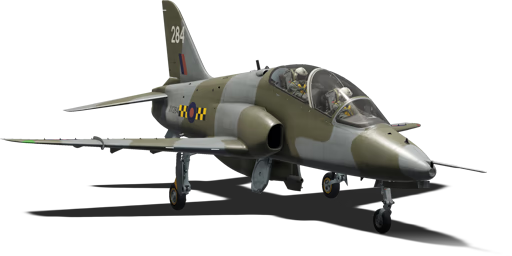
Hawk T Mk 1A



In 1964, the Royal Air Force requested the development of a fast trainer aircraft to replace the obsolete Folland Gnat. The SEPECAT Jaguar was initially considered for this role but was ultimately deemed too complex and expensive. In 1968, therefore, Hawker Siddeley began a private venture to create an aircraft that could be used for training or combat, depending on the customer’s requirements. In 1970, the Royal Air Force became interested in the aircraft and specified requirements for it. In March 1972, an order for 175 aircraft was signed. The prototype’s first flight took place on 21 August 1974, and it soon entered service as the Hawk T Mk 1. Over time, the aircraft attracted many foreign buyers looking to replace their old trainers, such as the A-4 and the Hunter. Among them was the United States, where the Hawk entered service as the T-45. In total, more than 1,000 Hawks of all variants were built.
One of the early variants was the Hawk T Mk 1A. It was distinguished by its ability to carry external ordnance, including a 30-millimeter ADEN cannon gun pod. A total of 89 aircraft were built to replace the obsolete Hawker Hunters as short-range interceptors. They remained in service until the early 2010s when they and the basic Hawk T.1 were phased out.
The Hawk T Mk 1A was introduced in Update 2.59 "Sky Odyssey". It is a small, lightweight aircraft designed for attacking ground targets with a limited range of external armament. Its flight characteristics are very similar to those of the Hawk 200, differing only in weight and engine power. However, since it faces less dangerous opponents, the Hawk can effectively counter them in a dogfight.

flaps
flaps
flaps
brake
| Name | Weight | Slot | ||||||
|---|---|---|---|---|---|---|---|---|
| 18 × | 183.9 kg |  | | |||||
| 254.9 kg |  | | ||||||
| 486 kg |  | | ||||||
| 281.9 kg |  | |||||||


Flight performance | |
|---|---|
Survivability |
|---|
Weaponry | |
|---|---|