
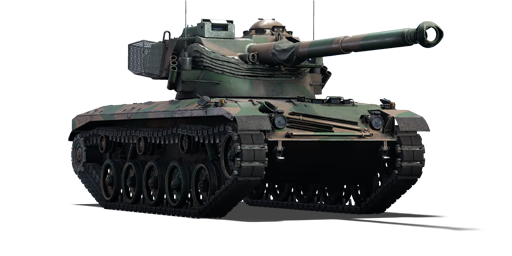
JaPz.K A2




The JaPz.K, also known as the SK-105 Kürassier, is an Austrian light tank developed by Saurer-Werk. In the early 1960s, the Austrian Army requested a modern light tank with protection against automatic cannons and high component commonality with other vehicles. Steyr-Daimler-Puch used the Saurer armored personnel carrier as a base for mounting a turret. French engineers proposed using the turret from the AMX-13 tank, which had been successfully tested in the Middle East and met the requirements of Steyr’s engineers. The turret was fitted with a 105mm gun and two six-round autoloading drums located in the rear of the turret. A later modification, the JaPz.K A2, featured an upgraded fire control system, an improved autoloader, and an increased ammunition load. Total production of SK-105 tanks exceeded 600 units, and an additional 48 armored recovery vehicles and 18 engineering vehicles were built. The Austrian Army was the largest operator, receiving 285 tanks (133 SK-105A1s and 152 SK-105A2s), 36 "Greif" recovery vehicles, and 18 engineering vehicles.
The Kürassiers were assigned to anti-tank and reconnaissance units. From 1995 to 1996, they were partially replaced by the Jaguar 1s purchased from Germany. By 2007, only the SK-105A2 tanks remained in active service in the 1st, 2nd, and 3rd Reconnaissance Battalions and the Tank School, while the SK-105A1 vehicles were placed in storage. As part of the reorganization and downsizing of the armed forces, the active fleet of Kürassiers was reduced to 60 units by 2010. In 2014, they were withdrawn from service, leaving only the recovery and engineering vehicles based on the chassis. The Kürassier remains in service with Argentina, Tunisia, Morocco, and Brazil.
The JaPz.K A2 was added in Update 2.5 "Ixwa Strike", alongside the French research tree variant. This lightly armored but well-armed tank excels as a tank destroyer. Its powerful gun, good fire control system, decent mobility, and relatively weak armor favor combat at long ranges. When such opportunities are unavailable, flanking maneuvers are the most effective approach in confined spaces. However, it's important to remember that a single enemy hit can often result in the vehicle's destruction.

| Ammunition | Type | Armor penetration (mm) at a distance: | |||||
|---|---|---|---|---|---|---|---|
| 10 m | 100 m | 500 m | 1000 m | 1500 m | 2000 m | ||
| HEAT | 400 | 400 | 400 | 400 | 400 | 400 | |
| HE | 25 | 25 | 25 | 25 | 25 | 25 | |
| APFSDS | 346 | 344 | 336 | 325 | 315 | 304 | |
| Smoke | 3 | 3 | 3 | 3 | 3 | 3 | |
| Belt | Belt filling | Armor penetration (mm) at a distance: | |||||
|---|---|---|---|---|---|---|---|
| 10 m | 100 m | 500 m | 1000 m | 1500 m | 2000 m | ||
| AP/T | 13 | 12 | 7 | 3 | 2 | 0 | |


 JaPz.K A2
Mobility | |
|---|---|
Protection |
|---|
Firepower | ||
|---|---|---|