
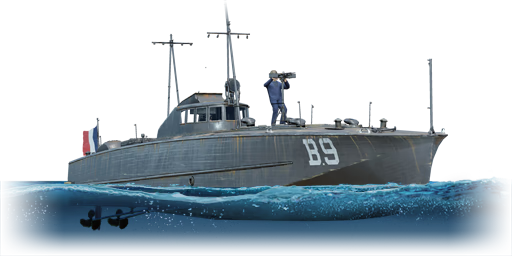
VTB-9



Construction of the French torpedo boats began after World War I, influenced by the success of Italian and British boats. In 1921, France purchased two Thornycroft boats from the United Kingdom: a 40-foot boat and a 55-foot boat, which became VTA-1 and VTB-1, respectively. These boats served as the basis for a series of experimental French-designed vessels, the VTB 2–7 and the VTA 2–4. However, due to their unsatisfactory performance, none of them entered mass production.
In 1928, the VTB-8, VTB-9, and VTB-10 prototypes were developed to address the shortcomings of earlier boats. They were armed with 7.7 mm machine guns for air defense and two torpedoes for engaging larger ships. The main difference between the boats was their torpedo launch systems. The VTB-8 was equipped with unreliable torpedo drop collar launchers, which were replaced by Schneider trough-type launchers on the VTB-9. The VTB-9 entered service in 1935 but broke apart and sank during a storm in August 1939.
The VTB-9 was introduced in Update 2.39, "Dance of Dragons". It is a fast boat with weak armaments, consisting only of two 7.7mm machine guns. Its torpedoes are weak but sufficient to sink a torpedo boat or subchaser. Compared to the VTB-8, this boat has a different design for its torpedo launchers.

| Belt | Belt filling | Armor penetration (mm) at a distance: | |||||
|---|---|---|---|---|---|---|---|
| 10 m | 100 m | 500 m | 1000 m | 1500 m | 2000 m | ||
| AP/T/AP/T | 10 | 9 | 8 | 7 | 6 | 5 | |
| AP/AP/AP/T | 10 | 9 | 8 | 7 | 6 | 5 | |
| IT/IT/IT/IT | 10 | 9 | 7 | 6 | 5 | 5 | |

 2 x (20 / 25) %
2 x 100 %
2 x (20 / 25) %
2 x 100 %
Seakeeping | |
|---|---|
Unsinkability | |
|---|---|
Firepower |
|---|