
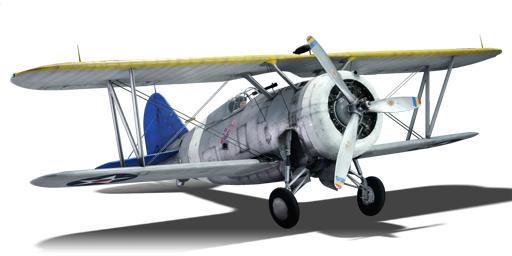
F3F-2



The Grumman F3F was the last biplane to enter American military service. It was designed for the US Navy in 1934 as an improved version of the previous F2F fighter, mainly to solve the problem of the plane struggling to recover from a flat spin. The F3F entered service in 1936, though its days were already numbered; wind tunnel tests and advancements in aircraft development had projected that monoplanes were the future. After just four years in service, the F3F was withdrawn in 1941 prior to the Pacific War, being replaced by the Brewster F2A Buffalo monoplane fighter, although some remained in service until 1943 as trainer aircraft. In total, 147 F3Fs of all variants were built.
The F3F-2 was introduced in Update 1.55 "Royal Armour". This peculiar biplane fighter is capable of reaching far higher speeds than its counterparts. Fitted with the 950 hp version of the Wright R-1820 Cyclone, it can reach an astounding ~506 mph (810 km/h) before overspeeding, making it capable of boom-and-zoom attacks. Its armament consists of one 12.7 mm and one 7.62 mm machine gun mounted in the nose. Although lacklustre, the F3F-2’s high speed performance more than makes up for it.

flaps
flaps
flaps
brake
| Belt | Belt filling | Armor penetration (mm) at a distance: | |||||
|---|---|---|---|---|---|---|---|
| 10 m | 100 m | 500 m | 1000 m | 1500 m | 2000 m | ||
| T/Ball/I/AP | 30 | 27 | 20 | 13 | 9 | 6 | |
| AP/AP/AP/T/I | 30 | 27 | 20 | 13 | 9 | 6 | |
| T/AP/AP/AP | 30 | 27 | 20 | 13 | 9 | 6 | |
| T/T/T/AP | 30 | 27 | 20 | 13 | 9 | 6 | |
| AP/I/AP | 30 | 27 | 20 | 13 | 9 | 6 | |
| Belt | Belt filling | Armor penetration (mm) at a distance: | |||||
|---|---|---|---|---|---|---|---|
| 10 m | 100 m | 500 m | 1000 m | 1500 m | 2000 m | ||
| T/Ball/Ball/Ball/AP/I | 13 | 12 | 7 | 3 | 2 | 0 | |
| T/AP/I | 13 | 12 | 7 | 3 | 2 | 0 | |
| AP/T/T/T/T | 13 | 12 | 7 | 3 | 2 | 0 | |
| AP/AP/AP/I/I | 13 | 12 | 7 | 3 | 2 | 0 | |


Flight performance | |
|---|---|
Survivability |
|---|
Weaponry | ||
|---|---|---|