
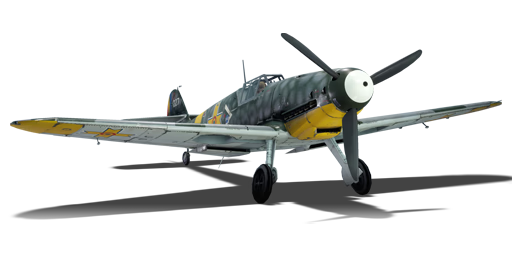
Bf 109 G-2



The Messerschmitt Bf 109 G-2 (nicknamed "Gustav") was a variant of the German Bf 109 single-engine fighter that was developed by Willy Messerschmitt's design team in late 1941. The first G-series fighters were a further development of the Friedrich, replacing the DB 601E engine with the more powerful DB 605A while maintaining similar dimensions. This upgrade improved the aircraft's overall performance. Meanwhile, the Luftwaffe increasingly required the Bf 109 as both a frontline fighter and an interceptor against heavy American and British bombers. By 1942, these bombers had become a growing threat to German industry. The first Gustav variant intended for this role was the G-1; however, the higher-priority version for frontline service was the Bf 109 G-2. Between May and December 1942, three factories produced 1,586 Bf 109 G-2 aircraft, most of which were sent to the Eastern Front to combat Soviet fighters.
In addition to serving in the Luftwaffe, the Bf 109 G-2 was supplied in large numbers to the air forces of several other nations, including Romania. Several hundred Gustav variants were delivered to the Romanian Air Force in total. The aircraft was also produced locally by IAR, which built 49 Bf 109 Ga-2 fighters. The "a" stands for "ausland," which means "foreign". These Messerschmitts served with the Romanian Air Force's 7th and 9th Fighter Groups and fought alongside the Luftwaffe until Romania switched sides and joined the Allies. One of these Gustavs was flown by 7th Fighter Group pilot Ioan Dicezare, who achieved sixteen confirmed and three probable victories.
The Romanian Bf 109 G-2 was introduced in Update 1.43 as a part of the German aircraft research tree. It is very similar to its predecessor, the Bf 109 F-4, offering balanced flight performance and effective armament. However, the Gustav is particularly effective in energy fighting and boom-and-zoom attacks thanks to the option of mounting two additional 20 mm MG 151 gun pods, allowing it to avoid prolonged dogfights. Additionally, the aircraft has extra armor protection for the pilot and rear fuel tank, giving it respectable survivability for a fighter of its class. In the game, it is presented in the Romanian camouflage of Romanian pilot Ioan Dicezare. Compared to the Bf 109 G-2/trop, it lacks the additional tropical air filter.

flaps
flaps
flaps
brake
| Belt | Belt filling | Armor penetration (mm) at a distance: | |||||
|---|---|---|---|---|---|---|---|
| 10 m | 100 m | 500 m | 1000 m | 1500 m | 2000 m | ||
| IT/IT/APHE/HEI | 20 | 18 | 10 | 5 | 4 | 4 | |
| IT/HEI/HEI/AP-I | 27 | 24 | 14 | 7 | 3 | 2 | |
| AP-I/HEI/HEI/HEI/HEI/IT | 27 | 24 | 14 | 7 | 3 | 2 | |
| APHE/APHE/APHE/IT | 20 | 18 | 10 | 5 | 4 | 4 | |
| FI-T/FI-T/FI-T/IT/IT | 10 | 9 | 5 | 3 | 2 | 1 | |
| HEI/HEI/HEI/APHE/AP-I | 27 | 24 | 14 | 7 | 3 | 2 | |
| Belt | Belt filling | Armor penetration (mm) at a distance: | |||||
|---|---|---|---|---|---|---|---|
| 10 m | 100 m | 500 m | 1000 m | 1500 m | 2000 m | ||
| AP-T/AP-I/AI | 9 | 8 | 6 | 3 | 0 | 0 | |
| AP-T/AP/AI/AP-I | 13 | 12 | 7 | 3 | 2 | 0 | |
| AP-T | 9 | 8 | 6 | 3 | 0 | 0 | |
| AI/AP/AP/AP/AI | 13 | 12 | 7 | 3 | 2 | 0 | |


 2 x (65 / 145 / 305) %
2 x 142 %
2 x (65 / 145 / 305) %
2 x 142 %
Flight performance | |
|---|---|
Survivability |
|---|
Weaponry | ||
|---|---|---|