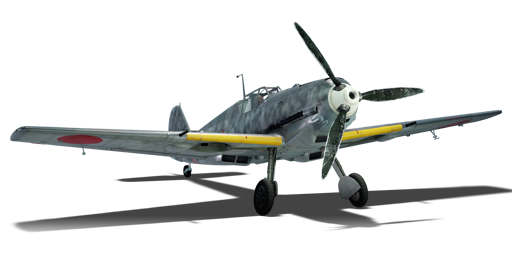



The Bf 109 E-7 was a variant of the German fighter aircraft Messerschmitt Bf 109, one of the first modern fighters of the Second World War era. The Bf 109 E-7 had a liquid-cooled, inverted V12 DB 601 engine and a 20 mm MG FF cannon in each wing. Japan acquired five Bf 109 E-7s from Germany in 1941 for testing purposes. The acquired planes bore the standard Hinomarus and yellow wing leading edges, as well as white numbers and a red stripe on the rudder. The Japanese Army compared the Bf 109 E-7s with their latest Ki-44 and found that the Bf 109 E-7 was inferior in every aspect. They assumed that Japanese aircraft development was on par with the newest Western fighters, unaware that the newer Bf 109 F was already available to German frontline troops. The planes were distributed across multiple air bases to train new pilots and for comparison with other Japanese aircraft. The main benefit Japan gained from the Bf 109 E-7 was the DB 601 engine licence, which enabled the Japanese to use a high-power inline engine in their own designs.
The Japanese Bf 109 E-7 has been in the game since the start of the Open Beta Test prior to Update 1.27 as the Bf 109 E-3; it was renamed the E-7 in Update 1.65 "Way of the Samurai". The E-7 is a variant of the Bf 109 E-3 with improved armament and performance. It replaces the MG FF cannons with MG FF/Ms that fire explosive Minengeschoß rounds. The E-7 can deliver a devastating burst of fire with its two wing-mounted MG FF/Ms, each with 60 rounds. The E-7 is an excellent energy fighter that can outclimb and outspeed most of its historical opponents. However, it may face more advanced aircraft such as the P-47D-25, which require careful tactics and energy management. The E-7 should avoid engaging these aircraft unless it has a clear energy advantage or can lure them into a low-speed, low-altitude dogfight. The E-7 is not a bad turner, especially with combat flaps, but it is still inferior to the Spitfire in this regard. The E-7 also has a heavier frame than the E-3, which reduces its agility. Turning should be used as a last resort or to finish off a damaged enemy.

flaps
flaps
flaps
brake
| Belt | Belt filling | Armor penetration (mm) at a distance: | |||||
|---|---|---|---|---|---|---|---|
| 10 m | 100 m | 500 m | 1000 m | 1500 m | 2000 m | ||
| IT/HEI/APHE | 15 | 13 | 8 | 4 | 4 | 4 | |
| IT/HEI/HEI/APHE | 15 | 13 | 8 | 4 | 4 | 4 | |
| FI-T/HEI/HEI/FI-T/HEI/HEI/APHE | 15 | 13 | 8 | 4 | 4 | 4 | |
| IT | 7 | 7 | 4 | 3 | 2 | 1 | |
| APHE/HEI/HEI/HEI/AP-I | 20 | 17 | 10 | 5 | 3 | 2 | |
| Belt | Belt filling | Armor penetration (mm) at a distance: | |||||
|---|---|---|---|---|---|---|---|
| 10 m | 100 m | 500 m | 1000 m | 1500 m | 2000 m | ||
| AP-T/AP-I/AI | 9 | 8 | 6 | 3 | 0 | 0 | |
| AP-T/AP/AI/AP-I | 13 | 12 | 7 | 3 | 2 | 0 | |
| AP-T | 9 | 8 | 6 | 3 | 0 | 0 | |
| AI/AP/AP/AP/AI | 13 | 12 | 7 | 3 | 2 | 0 | |

 2 x (50 / 225 / 230) %
2 x 124 %
2 x (50 / 225 / 230) %
2 x 124 %
Flight performance | |
|---|---|
Survivability |
|---|
Weaponry |
|---|