
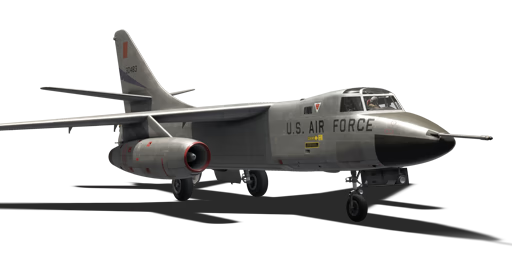
B-66B



The B-66B was an American tactical bomber that was developed from the Douglas A-3 Skywarrior for the US Air Force. Although the Air Force initially mocked the Navy’s aircraft, its prototype XA3D-1, which first flew in 1952, impressed the military with performance comparable to the much larger and costlier Boeing B-47 Stratojet. Since the Navy had already funded the design, the Air Force decided to adapt it for its own purposes. In June of that year, Douglas received a contract to build five reconnaissance aircraft that differed from the naval version mainly by the absence of carrier-specific features. These early aircraft were designated RB-66As and were nearly identical to the A-3.
However, the Air Force soon requested numerous modifications to the aircraft, necessitating many changes to the bomber’s design. The high-altitude bombing equipment was replaced with low-altitude systems. The fuselage and wings were completely redesigned. The J57 engines were replaced with weaker and less efficient J71 engines. The electrical and hydraulic systems were also redesigned, along with numerous modifications to the cockpit and landing gear. There were positive changes too—for example, the bomber was equipped with ejection seats, which the A-3 Skywarrior did not have. The new aircraft was designated the B-66 Destroyer. Five RB-66A reconnaissance aircraft were built according to the original design with few differences from the A-3. However, the RB-66B reconnaissance aircraft, incorporating all the aforementioned changes, entered serial production. The B-66B bomber variant was created based on the RB-66B. A total of 294 aircraft were built, including 72 B-66Bs. The last B-66s were withdrawn from US Air Force service in 1975.
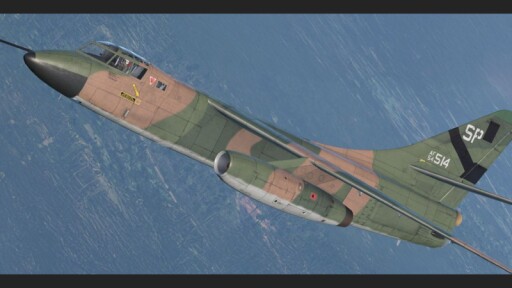
The B-66B was introduced in Update 2.49 “Tusk Force”. It is a heavy jet bomber with a large bomb load and a powerful defensive turret, but it is relatively slow and lacks the agility to escape most modern fighters or evade their missiles.

flaps
flaps
flaps
brake
| Belt | Belt filling | Armor penetration (mm) at a distance: | |||||
|---|---|---|---|---|---|---|---|
| 10 m | 100 m | 500 m | 1000 m | 1500 m | 2000 m | ||
| AP-T/HEF-I/HEF-I | 36 | 33 | 23 | 15 | 9 | 6 | |
| AP-T/HEF-I/I | 36 | 33 | 23 | 15 | 9 | 6 | |
| HEF-I/HEF-I/I/AP-T | 36 | 33 | 23 | 15 | 9 | 6 | |
| AP-T/AP-I/AP-I/AP-I | 36 | 33 | 23 | 15 | 9 | 6 | |
| HEF-I/AP-I/HEF-I/I | 36 | 33 | 22 | 14 | 9 | 5 | |
| Name | Weight | Slot | ||||||
|---|---|---|---|---|---|---|---|---|
| 14 × | 5,073.9 kg |  | ||||||
| 4 × | 5,479.2 kg |  | ||||||


Flight performance | |
|---|---|
Weaponry | |
|---|---|