
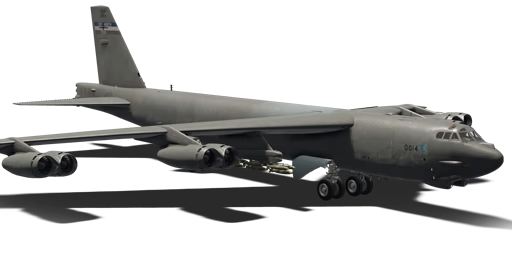

The Boeing B-52 Stratofortress is an American long-range strategic bomber. In 1946, the U.S. Air Force issued specifications for a jet aircraft with an 8,000 km range. Boeing won the competition, and development of the YB-52 prototype began in 1951. The first flight took place on 15 April 1952, and mass production began in 1954. In total, around 740 aircraft of various modifications were produced.
The first variant was the B-52A, a pre-production batch of three aircraft for testing. The B-52B variant featured new Pratt & Whitney J57-P-19W engines and entered service in 1955. The B-52C had reinforced equipment and a white underside to protect against light radiation. The B-52D was equipped with an improved machine gun fire control system. The B-52E received updated avionics and a bombing navigation system. The B-52F featured engines with an enhanced water injection system, new generators, and a modified wing design. The most numerous variant was the B-52G, of which 193 were produced. This variant featured a 2.4-metre shorter tail, integral fuel tanks instead of flexible ones, and remote control of the tail turret. All of these changes increased the range. The B-52H variant first flew on 10 July 1960. Its main distinguishing feature was its Pratt & Whitney TF33 twin-spool turbofan engines. These increased the range and reduced fuel consumption. The tail section was reinforced, the avionics were upgraded, the machine guns were replaced with a 20 mm M61 Vulcan cannon and an in-flight refuelling system was added. New sights were also installed. Production of the B-52H ended in October 1962, with a total of 102 aircraft built.
The B-52 first saw combat in Vietnam during Operation Linebacker II in December 1972. It later participated in Operation Desert Storm in 1991, the war in Yugoslavia in 1999, and operations over Afghanistan and Iraq. It also carried out airstrikes against Iran in 2026. As of 2026, despite being over 60 years old, the B-52H remains in service with the U.S. Air Force and is regularly upgraded.
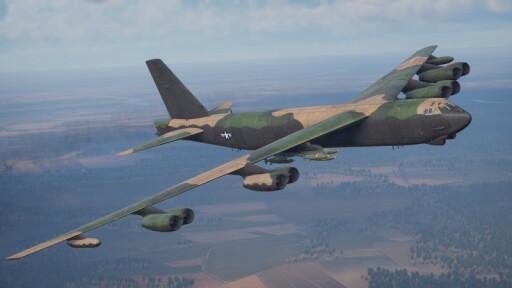
The B-52H was introduced as one of the rewards for the 2026 "Nuclear Thunder" event. It is a bomber with decent speed and is capable of carrying up to 30 tons of payload. For defense, it has only a 20mm cannon, RWR, and countermeasures. Combined with its enormous size, these defenses are still inadequate and make the B-52H dependent on allies.

flaps
flaps
flaps
brake
| Belt | Belt filling | Armor penetration (mm) at a distance: | |||||
|---|---|---|---|---|---|---|---|
| 10 m | 100 m | 500 m | 1000 m | 1500 m | 2000 m | ||
| HEF-I/API-T/AP-I | 40 | 36 | 21 | 11 | 6 | 3 | |
| HEF-I/HEF-I/API-T/HEF-I/HEF-I/AP-I | 40 | 36 | 21 | 11 | 6 | 3 | |
| API-T/AP-I/AP-I/AP-I/HEF-I | 40 | 36 | 21 | 11 | 6 | 3 | |
| HEF-I/AP-I/AP-I | 40 | 36 | 21 | 11 | 6 | 3 | |
| Name | Weight | Slot | ||||
|---|---|---|---|---|---|---|
| 12 × | 3,040.8 kg |  | | |||
| 12 × | 3,040.8 kg |  | | |||
| 12 × | 4,499 kg |  | | |||
| 12 × | 4,499 kg |  | | |||
| 6 × | 5,511.6 kg |  | | |||
| 9 × | 2,298.1 kg | | | | ||
| 9 × | 2,298.1 kg | | | | ||
| 9 × | 3,391.8 kg | | | | ||
| 9 × | 3,391.8 kg | | | | ||
| 3 × | 2,810.8 kg |  | | | ||



Flight performance | |
|---|---|
Weaponry | |
|---|---|