
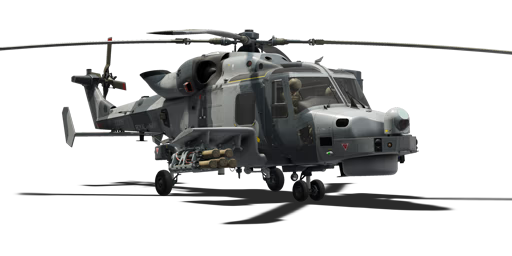
Wildcat HMA2



The development of the AW159 Wildcat was driven by the Army Air Corps' and the Royal Navy's need to replace their Lynx and Army Gazelle helicopters. Development began in the 1990s. AgustaWestland was tasked with creating the "Future Lynx" platform, either by deeply modernizing the existing fleet or developing a new aircraft. By the mid-2000s, the first approach was deemed unpromising, and work began on a new Lynx. This helicopter was later redesignated the AW159 Wildcat.
The new helicopter was equipped with modern systems, including a glass cockpit, upgraded radar, radar warning receivers, countermeasures, and a new powerplant consisting of LHTEC CTS800-4N turboshaft engines. The Army Air Corps operates the AH1 variant, and the Royal Navy operates the AW159 Wildcat HMA2. Several other countries, including South Korea, the Philippines, and Algeria, have adopted the Wildcat or placed orders for it.
The Wildcat HMA2 was introduced in Update 2.59 "Sky Odyssey". The Wildcat's main feature is its unique LMM Martlet missiles, of which it can carry up to 20. These missiles have a relatively small warhead but make up for this with high speed and a range of up to six kilometers. They are also capable of engaging lightly armored ground and aerial targets. For more heavily armored targets, the Wildcat is equipped with Spike NLOS missiles, which are an adaptation of an existing missile family with an increased flight range. Like its spiritual predecessor, the Lynx, the new helicopter has powerful engines that allow it to maneuver quickly and evade incoming missiles. However, the helicopter still lacks any decent armor protection, so one must be vary of return fire before launching missiles.

| Name | Weight | Slot | ||||
|---|---|---|---|---|---|---|
| 5 × | 87 kg |  | | | | |
| 2 × | 120 kg |  | | |||
| Spike NLOS targeting pod | 15 kg |  | ||||


 Wildcat HMA2
Flight performance | |
|---|---|
Survivability |
|---|
Weaponry | |
|---|---|