
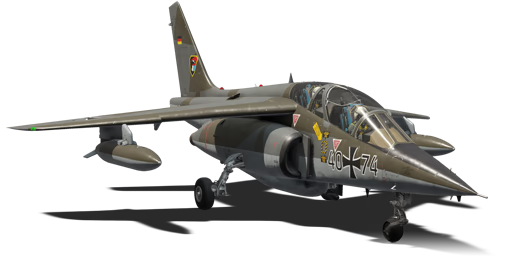
Alpha Jet A (JaboG 41)



The Alpha Jet A was a light attack aircraft that was jointly developed by the German company Dornier and the French firm Dassault-Breguet. Development began in the 1960s. The French prototype made its first flight in October 1973, followed by the German prototype in January 1974. The first production German Alpha Jet made its maiden flight on April 2, 1978, and deliveries to the armed forces began in March 1979. By 1983, the Luftwaffe had acquired a total of 175 aircraft to replace its fleet of Fiat G.91 R/3s. Despite modernization attempts, the Alpha Jet A was withdrawn from German service in 1992, with some aircraft transferred to Portugal.
One of the squadrons that operated the Alpha Jet A was Jagdbombergeschwader 41 (JaboG 41), the 41st Fighter-Bomber Wing. JaboG 35, its predecessor, was established on October 1, 1959, in Husum with F-84F and T-33A aircraft. Beginning in August 1963, the wing transitioned to the G.91 R/3, completing the process in 1965. On January 1, 1966, JaboG 35 reorganized as the 41st Light Attack Wing (Leichtes Kampfgeschwader 41, LeKG 41). Prior to transitioning to the Alpha Jet A on October 1, 1980, it was again reorganized into JaboG 41. In total, JaboG 41 received 51 Alpha Jet A aircraft, including 14 two-seaters. Following the downsizing of the German Army after reunification and the adoption of Luftwaffenstruktur 4, the decision was made to disband the wing. As early as December 12, 1991, the aircraft began being withdrawn from service. The final flight of the Alpha Jet A as part of JaboG 41 took place on January 21, 1993, and the wing was disbanded on March 31.
The Alpha Jet A (JaboG 41) was introduced in Update 2.55 "Ninth Wave". It differs from the standard Alpha Jet A due to its unique livery from the JaboG 41. Otherwise, it is the same ground-attack aircraft, well-suited for mixed battles thanks to its maneuverability, countermeasures, and selection of external armaments. However, the aircraft can also be dangerous in dogfights due to its small size, good handling, and powerful cannon. Drawbacks include the lack of RWR and poor acceleration above 700 km/h.

flaps
flaps
flaps
brake
| Name | Weight | Slot | ||||
|---|---|---|---|---|---|---|
| 247 kg |  | | | | ||
| 264 kg |  | | | | ||
| 240.9 kg |  | | | | ||
| 254 kg |  | | | | ||
| 310.7 kg |  | | | | ||
| 19 × | 233.7 kg |  | | | | |
| Drop tank (310 liters) | 120 kg |  | | |||
| 2 × | 481.8 kg |  | | |||
| 2 × | 508 kg |  | | |||
| 2 × | 494 kg |  | | |||
| 2 × | 528 kg |  | | |||
| 38 × | 467.5 kg |  | | |||
| 351 kg |  | |||||


 2 x (115 / 340 / 600) %
2 x 220 %
2 x (115 / 340 / 600) %
2 x 220 %
Flight performance | |
|---|---|
Survivability |
|---|
Weaponry | |
|---|---|