
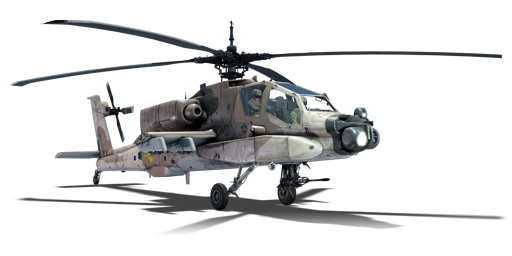
▃AH-64A Peten



In the 1980s, Israel was in need of a new attack helicopter to replace the ageing MD-500 and AH-1 platforms in ground support and anti-tank roles. Instead of upgrading these outdated platforms, Israel turned to the US and the AH-64. Being actively involved in the Apache program since 1983, Israel was the first operator of the AH-64 outside the US, with the first batch of production helicopters being delivered on 11 September 1990. By 2000, there were 42 AH-64A aircraft in Israeli service, nicknamed “Peten”, which translates to “Cobra”.
Introduced in Update “Wind of Change”, the AH-64A Peten is one of the earliest versions of the AH-64A in Israeli service, missing many of the upgrades that its tech-tree counterpart has. It features a wide variety of weapons ranging from the laser-guided AGM-114 Hellfire to the unguided Hydra-70 rocket, as well as two pairs of ATAS air-to-air guided missiles. The helicopter’s flight performance is also excellent for its size, with a decent top speed and above average manoeuvrability for a heavy attack helicopter. The Peten is additionally equipped with a chin-mounted 30mm autocannon with a wide angle of fire and dual-purpose shells, as well as powerful optics paired with a high-resolution thermal imager and an IRST system allowing for both short and long-range engagements.

| Belt | Belt filling | Armor penetration (mm) at a distance: | |||||
|---|---|---|---|---|---|---|---|
| 10 m | 100 m | 500 m | 1000 m | 1500 m | 2000 m | ||
| HEDP | 51 | 51 | 51 | 51 | 51 | 51 | |
| Name | Weight | Slot | ||||||
|---|---|---|---|---|---|---|---|---|
| 4 × | 40.4 kg |  | | |||||
| 19 × | 231.6 kg |  | | | | |||
| 2 × | 128.3 kg |  | | | | |||
| 4 × | 198.5 kg |  | | | | |||


 2 x (50 / 265 / 365) %
2 x 232 %
2 x (50 / 265 / 365) %
2 x 232 %
Flight performance |
|---|
Survivability |
|---|
Weaponry | |
|---|---|