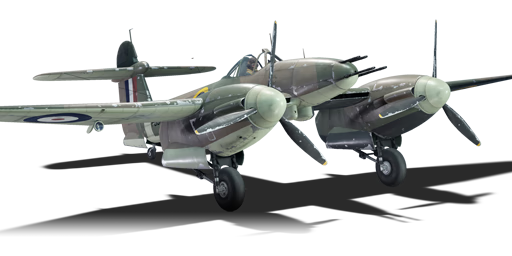



The Whirlwind's history began when the British Air Ministry issued Specification F.37/35 in 1935, calling for the development of a new heavy fighter equipped with four 20mm cannons. Several companies participated in the development process, but by February 1937, only Westland remained in the competition with its design. On October 11, 1938, the Westland P.9 prototype made its first flight. The company had created a fast, fairly maneuverable fighter equipped with four 20 mm Hispano Mk. I cannons and two Rolls-Royce Peregrine engines. Soon after, a second aircraft also took to the skies. Tests were conducted until 1939, and the Westland fighter was very well received by the Air Force as a result. They named it the Whirlwind and ordered 200 Mk I aircraft. However, production ceased in 1942 after only 112 aircraft had been built because Rolls-Royce stopped producing new Peregrine engines due to an overwhelming number of orders for the more advanced Merlin engine. The Whirlwinds served the British Air Force in the European theater for only three years, until they were declared obsolete and replaced by the Hawker Typhoon on January 1, 1944.
The Whirlwind Mk I was introduced in Update 1.75 "La Résistance". It is a heavy fighter with powerful armament and good maneuverability. However, it has a low maximum speed and quickly loses maneuverability above 500 km/h. Additionally, it has a very small ammunition load of only 60 shells per gun.

flaps
flaps
flaps
brake
| Belt | Belt filling | Armor penetration (mm) at a distance: | |||||
|---|---|---|---|---|---|---|---|
| 10 m | 100 m | 500 m | 1000 m | 1500 m | 2000 m | ||
| HEI/SAP-I/T | 22 | 20 | 14 | 9 | 6 | 4 | |
| AP-T/HEI/SAP-I | 37 | 35 | 25 | 16 | 10 | 7 | |
| AP-T/T/HEI | 37 | 35 | 25 | 16 | 10 | 7 | |
| AP-T/SAP-I/HEI/AP-T | 37 | 35 | 25 | 16 | 10 | 7 | |
| HEI/HEI/SAP-I | 22 | 20 | 14 | 9 | 6 | 4 | |


 Whirlwind Mk I
Flight performance | |
|---|---|
Survivability |
|---|
Weaponry | |
|---|---|