
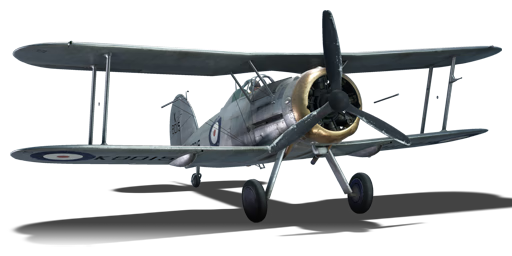



The Gloster Gladiator Mk. II was a variant of the Gloster Gladiator, a British biplane fighter aircraft developed in the 1930s. The Gladiator was the last biplane fighter to serve in the Royal Air Force. Produced from 1938 to 1939, the Mk.II differed from the Mk.I in that it featured a more powerful Bristol Mercury VIIIA/AS engine instead of a Bristol Mercury IX engine. A total of 270 Gladiator Mk.IIs were built and served on various fronts during the Second World War.
British World War II ace Robert R. Stanford Tuck flew the Gladiator while serving with No. 65 Squadron RAF. Between 1939 and 1942, he destroyed 29 enemy aircraft and received several awards, including the Distinguished Flying Cross. He was held captive by the Germans from 1942 to 1945 and was liberated by Soviet troops.
The Tuck's Gladiator Mk II was introduced in Update 1.31. This model stands out for its distinctive paint scheme, which matches that of Tuck's aircraft. Although well-armed and highly manoeuvrable, this biplane has a poor climb rate and quickly loses its modest speed when making sharp turns. Despite these drawbacks, the Gladiator Mk.II is one of the best biplanes and is well suited to dogfights.

flaps
flaps
flaps
brake
control
| Belt | Belt filling | Armor penetration (mm) at a distance: | |||||
|---|---|---|---|---|---|---|---|
| 10 m | 100 m | 500 m | 1000 m | 1500 m | 2000 m | ||
| T/AP/AP-I/Ball/Ball/I | 13 | 12 | 7 | 3 | 2 | 0 | |
| T/AP/AP-I/AP-I/I | 13 | 12 | 7 | 3 | 2 | 0 | |
| IT/AP-I | 13 | 12 | 7 | 3 | 2 | 0 | |
| AP-I/AP-I/I | 13 | 12 | 7 | 3 | 2 | 0 | |

 2 x (15 / 25 / 70) %
2 x 75 %
2 x (15 / 25 / 70) %
2 x 75 %
Flight performance | |
|---|---|
Survivability |
|---|
Weaponry |
|---|